
Article: Phoenician Glass: The Ancient Craft Kept Alive in Hebron
Phoenician Glass: The Ancient Craft Kept Alive in Hebron
Glass has been made in the land of Palestine for thousands of years. Long before it became a medium for industrial production, long before factories and moulds and automation, glassblowing was a craft, a living, breathing art form in which a human being gathered molten glass on the end of a pipe, blew air into it with their lungs, and shaped it with their hands, their tools, and generations of accumulated knowledge.
In Hebron, glassblowing has deep roots, but the specific Phoenician technique that gives this glass its extraordinary character was lost for centuries, and its revival is the story of one remarkable craftsman. The city of al-Khalil has been a center of glass production for centuries, and it was in Hebron that the Phoenician glassblowing tradition was painstakingly brought back to life.
This is the story of Palestinian Phoenician glass: where it comes from, what makes it extraordinary, and why it matters that it is still being made.
The Phoenicians and the Origins of Glassblowing

The Phoenicians were an ancient Semitic civilization that flourished along the eastern Mediterranean coast in Bilad al-Sham (often referred to as the Levant), the region that today includes Lebanon, Palestine, and parts of Syria, from around 1500 BCE onward. They were among the greatest seafarers and traders of the ancient world, establishing networks of commerce and culture that stretched from Bilad al-Sham to the coasts of North Africa, Spain, and beyond.
Among their most important contributions to human civilization was the development of glassblowing. While glass itself had been made in the ancient world for centuries before in Egypt and Mesopotamia, the Phoenicians are credited with developing the technique of gathering molten glass on a blowpipe and inflating it into vessels, a method that would revolutionize the production of glass objects and spread across the ancient world.
This technique, blowing air through a hollow pipe into a gather of molten glass, is fundamentally the same technique used by Hebron's glass artisans today. The pipe has changed. The furnace has changed. But the essential act of a human being breathing life into molten glass, shaping it with their hands and their breath, has remained continuous from the Phoenicians to the present day.
Bilad al-Sham, the broader region in which Palestine sits, was central to the development and spread of glassblowing throughout the ancient and medieval world. Glass workshops operated in the region for millennia. The knowledge and technique were passed from one generation of craftspeople to the next in workshops, in families, in cities like Hebron, where the tradition took particularly deep root.
Hebron Glass And the Man Who Revived a Lost Technique
Hebron Al-Khalil has been a center of glassblowing for centuries. The city's glass workshops have been documented across the medieval and Ottoman periods, and the craft has continued in various forms to this day.
But here is something important to understand: the specific Phoenician glassblowing technique the distinctive method that produces the swirled, metal-flecked designs that make Phoenician glass so recognizable was lost to Palestinian glassblowers for hundreds of years, possibly longer. It was not a continuous tradition that survived unbroken. It stopped. The knowledge of how to produce that specific style of glass disappeared from Hebron's workshops.
What brought it back was one man: Tawfiq Netshe.
Tawfiq Netshe, a master glassblower in Hebron, saw examples of ancient Phoenician glass vessels in museums objects that showed the distinctive swirled, metal-inlaid style that the Phoenicians had developed millennia ago. He became fascinated. He found books about the technique. He began to experiment in his workshop, blowing, failing, adjusting, trying again. Over more than a decade of experimentation and self-teaching, he worked out how to produce the Phoenician technique himself. He then taught other glassblowers, bringing the technique back to life in Hebron.
This is not a story of an unbroken tradition. It is a story of one person's determination to revive something that had been lost, to look at an object in a museum and ask, "How was this made?" and then spend years finding out. Tawfiq Netshe's achievement is the reason Phoenician glass exists in Hebron today.
At Handmade Palestine, we work directly with Tawfiq Netshe's workshop in Hebron. Every piece of Phoenician glass in our collection was made there by Tawfiq and the glassblowers he has trained in the technique he spent years recovering.
How Hebron Glass Is Made
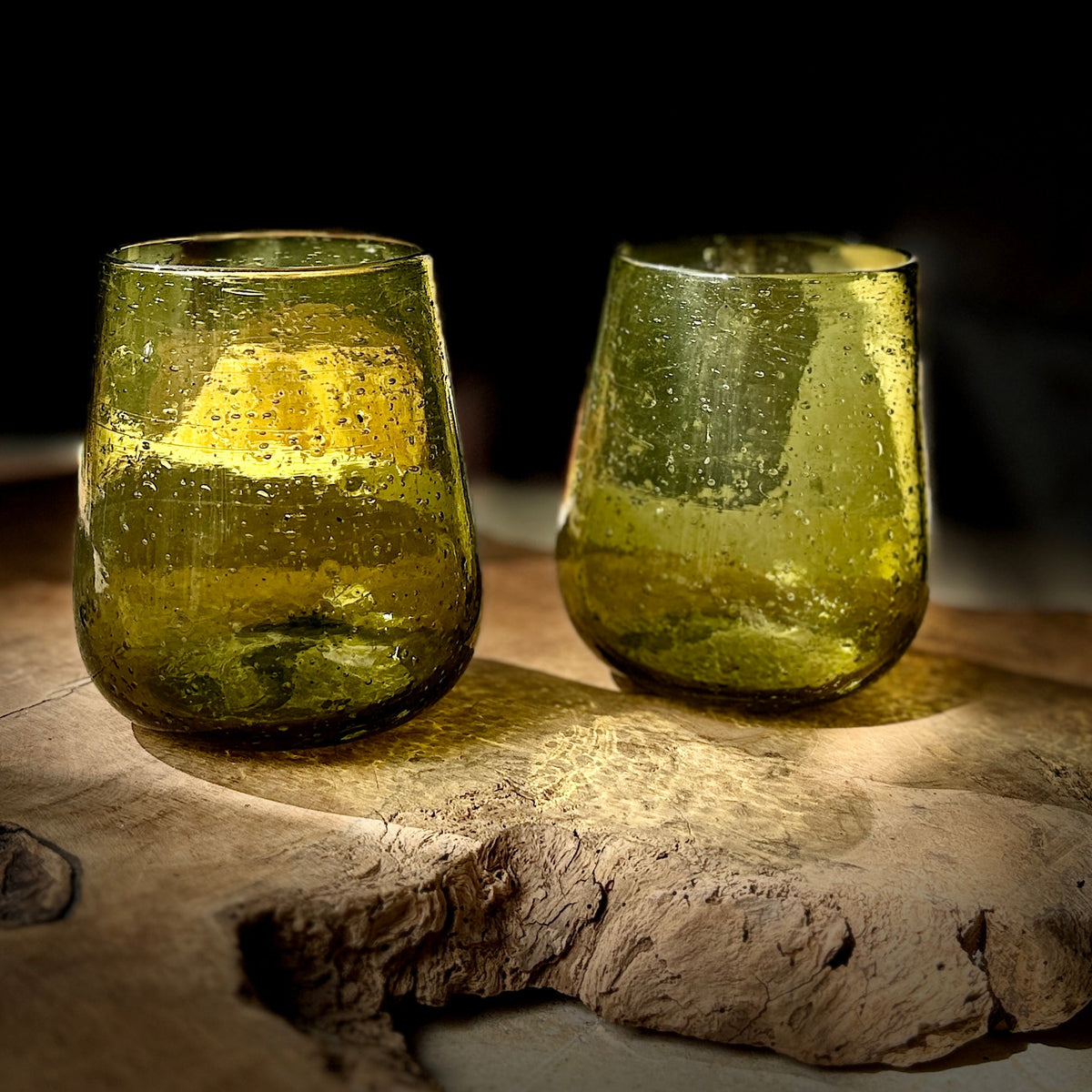
Phoenician glassblowing in Hebron is entirely handmade. There are no moulds, no machine-formed blanks, no industrial shortcuts. Every piece begins as raw material recycled glass, gathered and melted in a furnace at temperatures exceeding 1,000 degrees Celsius and ends as a finished object shaped entirely by the glassblower's skill.
Gathering. The glassblower inserts a blowpipe, a long hollow metal rod, into the molten glass in the furnace and gathers a gather of glass on the end of the pipe. The amount gathered determines the size of the finished piece.
Blowing. The glassblower blows air through the pipe into the gather of molten glass, inflating it into a bubble. The size and shape of the bubble are controlled by the force and duration of the blow, the position of the pipe, and the continuous rotation of the pipe that keeps the glass from drooping under gravity.
Shaping. While the glass is still molten and workable, the glassblower uses tools such as metal paddles, wooden blocks, shears, and jacks to shape the piece. The neck of a drinking glass is formed by constricting the glass with jacks. The base is shaped by pressing against a flat surface. Handles and decorative elements are added by gathering additional glass and attaching it while both pieces are still molten.
Coloring with recycled glass. Hebron's glass workshops work with recycled glass, a very different raw material from the virgin glass used in most commercial glassblowing. The four base colors of Phoenician glass from Hebron deep blue, turquoise, amber, and green come from the colors of recycled glass available to the workshop, not from a free choice of any color possible. Working with recycled glass requires a completely different set of skills. When Hebron glassblowers have visited glass studios in other countries where virgin glass is used, they have found the material genuinely difficult to work with, not because of any lack of skill, but because recycled and virgin glass behave differently in the furnace and on the pipe.
The Phoenician technique uses brass and silver in the glass. What makes Phoenician glass Phoenician is not just color but a specific technique: small flecks of brass and silver are swirled into the molten glass as it is being blown. These metal flecks become embedded within the glass itself not painted on the surface, not applied as a coating, but physically inside the material. The result is a glass that appears almost painted, with a swirling, marbled pattern of metallic shimmer running through it. When you hold a piece of Phoenician glass up to sunlight, you can see clearly that the design is not on the surface; it is within the glass, suspended there by the glassblower's technique.
Annealing. Once formed, the piece is placed in an annealing oven, a lower-temperature furnace where it cools slowly and evenly. This controlled cooling prevents the glass from cracking from thermal stress. The annealing process takes several hours.
The result is an object of genuine craft, irregular in a way that reveals the human hand that made it, distinctive in color and form, and carrying within it the specific skill and knowledge of a Hebron glassblower whose family has practiced this craft for generations.
What Handmade Palestine Offers: The Products
Our Phoenician glass collection includes pieces for daily use and for display, each one hand-blown in the Netshe workshop in Hebron.
Highball drinking glasses: tall, elegant drinking glasses hand-blown in the traditional Phoenician style. Each glass is unique in its precise dimensions and color variation.
Lowball tumblers: shorter, wider drinking glasses suited to juice, water, or cocktails. Available in sets.
Stemless wine glasses: hand-blown stemless wine glasses in the Phoenician tradition, beautiful on a table and exceptional to drink from.
Glass drink pitcher: a hand-blown pitcher for water, juice, or cold drinks; a centerpiece for any table.
Flower vases: hand-blown vases in the rich colors of Hebron glass: cobalt blue, turquoise, amber, and green. Each one is a unique object that brings Palestinian craft into any room.
Tea candle holders: small, beautiful hand-blown glass candle holders that glow with the characteristic colors of Hebron glass when lit.
Why Each Piece Is Unique
Because every piece of Hebron Phoenician glass is made by hand, no two pieces are exactly alike. The precise dimensions, the exact shade of color, the specific form of the rim or base these will vary from piece to piece, even within the same product line.
This is not a defect. It is the defining quality of handmade glass: the physical evidence that a human being, not a machine, made this object. The slight irregularity in the rim of a Hebron drinking glass is the mark of the glassblower's hand. The way the color shifts from lighter to darker across the body of a vase reflects the movement of the glass as it was shaped, the specific way the molten material flowed and settled under the glassblower's guidance.
Handmade Palestinian Phoenician glass is never perfect in the machine sense. It is perfect in the human sense: an object that carries within it the marks of its own making and the specific skill of the person who made it.
Phoenician Glass as a Gift
Palestinian Phoenician glass makes an extraordinary gift: a functional, beautiful object with a history stretching back to ancient Bilad al-Sham, made by hand in Hebron by artisans whose family has practiced this craft across generations.
A set of hand-blown Hebron drinking glasses transforms the experience of a shared meal. A Phoenician glass vase brings Palestinian craft into a room in a way that people will notice and ask about. A tea candle holder lit on a winter evening glows with the specific colors of Palestinian glass that no factory has ever quite managed to replicate.
These are gifts people use and live with, not objects that sit in a drawer.
Shop Palestinian Phoenician glass →
Caring for Your Hebron Glass
Washing: Hand washing is recommended for all Phoenician glass pieces. The hand-blown form of these pieces means that they may have slight irregularities that can make them more susceptible to thermal stress in dishwashers. Wash gently with warm water and mild soap.
Handling: Treat your Phoenician glass with the same care you would give any quality handmade glassware. The glass is durable for everyday use but should be handled carefully to avoid impacts.
Display: If displaying glass pieces on a shelf or table, keep them out of direct strong sunlight for extended periods, which can affect some glass colors over time.
Conclusion
Tawfiq Netshe looked at ancient Phoenician glass in a museum and spent over a decade teaching himself how to make it. That act of determination, refusing to accept that something beautiful was permanently lost, is the reason you can hold a piece of Phoenician glass today. Every piece from Hebron carries not just an ancient tradition but the very specific story of one man who brought it back.
Shop Palestinian Phoenician glass →
Frequently Asked Questions
Q: What is Phoenician glass?
A: Phoenician glass refers to hand-blown glass made in the tradition developed by the Phoenicians, the ancient Bilad al-Sham civilization credited with developing glassblowing around 1500 BCE. In Palestine, this tradition has been kept alive in Hebron, where master glassblowers continue to produce hand-blown glass using techniques rooted in this ancient tradition.
Q: Where is Handmade Palestine's glass made?
A: Our Phoenician glass is made in Hebron (Al-Khalil) by the Netshe workshop, one of Hebron's oldest glassblowing families, whose craft has been passed from generation to generation for centuries.
Q: What makes Phoenician glass look the way it does?
A: Two things together. First, the four base colors deep blue, turquoise, amber, and green come from the recycled glass that Hebron's workshops use as their raw material. Second, and most distinctively, small flecks of brass and silver are swirled into the molten glass during blowing. These metal flecks become embedded inside the glass itself, not painted on the surface, creating the characteristic swirled, marbled, almost painted appearance. When held up to light, you can see clearly that the design is within the glass, not on it.
Q: Is Phoenician glass dishwasher safe?
A: Hand washing is recommended. The hand-blown form of these pieces means they may have slight irregularities that make them more susceptible to thermal stress. Hand washing preserves both the glass and its color.
Q: Why does each piece look slightly different?
A: Because each piece is made entirely by hand by an individual glassblower. No two pieces are identical; the precise dimensions, color distribution, and form will vary from piece to piece. This variation is the mark of genuine handcraft, not a defect.
Written by Morgan Totah
Visit author's website


Leave a comment
This site is protected by hCaptcha and the hCaptcha Privacy Policy and Terms of Service apply.