
The Watermelon as a Symbol of Palestine: History, Meaning, and Why It Matters
Few symbols in recent years have traveled as far or as fast as the watermelon. From protest marches to social media, from gallery walls to jewelry, the image of a watermelon slice red flesh, white rind, green skin, black seeds has become one of the most widely recognized symbols of Palestinian solidarity in the world.
But the watermelon is not a new symbol. Its connection to Palestinian identity stretches back decades, rooted in a specific moment of occupation and resistance, and its meaning has deepened with every passing year.
This guide tells the full story of the watermelon as a Palestinian symbol: where it came from, what it means, why it has endured, and why wearing it matters.
Where the Watermelon Symbol Came From
The story of the watermelon as a Palestinian symbol has a specific and remarkable origin, one that begins with an act of censorship and ends with the censor inadvertently creating the very symbol he was trying to prevent.

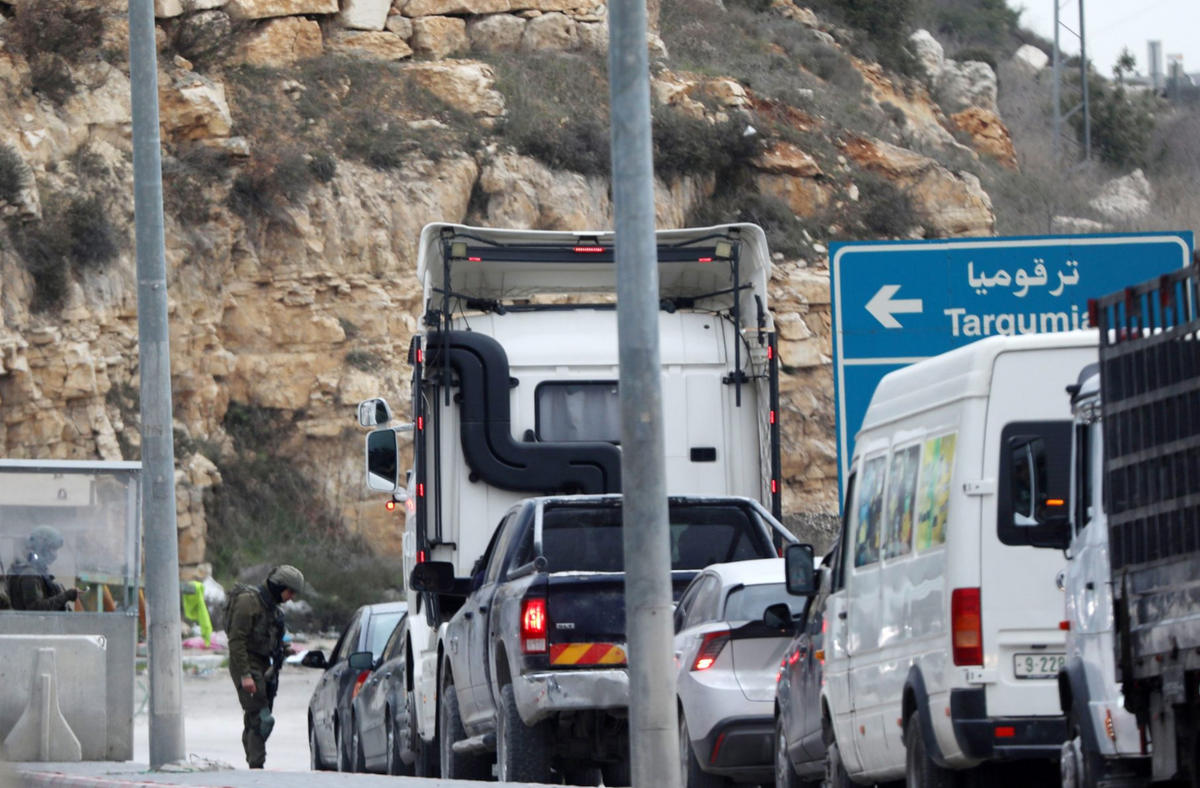
After Israel's occupation of the West Bank and Gaza following the 1967 war, Israeli military authorities prohibited the public display of the Palestinian flag in the occupied territories. The ban extended beyond the flag itself; displaying the four colors of the flag together (red, green, black, and white) in any form was treated as a political offense that could lead to confiscation or arrest.
In 1980, Israeli military forces shut down an exhibition at Gallery 79 in Ramallah, an art gallery founded by Issam Badr, after soldiers deemed the works political because they incorporated the colors of the Palestinian flag. The exhibition featured work by three Palestinian artists: Sliman Mansour, Nabil Anani, and Issam Badr. The artists were later summoned by an Israeli military officer, who informed them that they were forbidden from exhibiting without prior military approval and forbidden from painting in the colors of the Palestinian flag.
The officer also tried to persuade them to abandon political art altogether. "He was trying to convince us not to do any political art," Mansour later recalled, "saying to us, 'Why do you do political art? Why don't you paint nice flowers or a nude figure? It's nice. I will even buy from you.'"
One of the artists, Issam Badr, pushed back. He asked the officer: if he painted a flower using those colors, what would happen? The officer's reply was unambiguous: "Even if you paint a watermelon, it will be confiscated."
The watermelon, which naturally bears the four colors of the Palestinian flag in its red flesh, white rind, green skin, and black seeds, had just been named by the censor himself as a prohibited image. The artists took note. In protest, Palestinians began carrying watermelons publicly, waving slices in the streets. Palestinian artists began painting watermelons. The image that the Israeli officer had tried to prohibit became, because of that prohibition, one of the most powerful symbols of Palestinian identity.
Sliman Mansour, now widely recognized as one of the most important Palestinian artists of his generation, has confirmed this account in multiple interviews. The watermelon symbol, he has said, came directly from that encounter, from the soldier's own words.
When the Oslo Accords in 1993 lifted the ban on the Palestinian flag, the watermelon did not disappear. By then, it had taken on a life of its own, not just a substitute for the flag, but a symbol in its own right, carrying the memory of the censorship that had created it and the creativity of the resistance that had responded.
What the Watermelon Represents Today
Today, the watermelon symbol carries several layers of meaning simultaneously.
Palestinian national identity. The four colors of the watermelon red, white, green, and black are the four colors of the Palestinian flag. Displaying or wearing a watermelon is an expression of Palestinian identity, a way of saying "I am Palestinian" or "I stand with Palestinians" that is visually immediate and universally understood within Palestinian communities and solidarity movements worldwide.
Creative resistance. The watermelon emerged as a form of resistance to censorship, a creative, nonviolent way of maintaining identity under conditions designed to erase it. This history gives the symbol an additional layer of meaning beyond its colors. It represents Palestinian ingenuity, the refusal to be silenced, and the ability to find beauty and creativity even under the most constrained conditions.
Sumud steadfastness. Like the olive tree, the watermelon has come to represent the Palestinian concept of sumud: the steadfast refusal to disappear, to be erased, to give up connection to identity and land. The watermelon persisted through prohibition. It is still here. So are Palestinians.
Global solidarity. Since October 2023, the watermelon emoji 🍉 has become one of the most widely used symbols of Palestinian solidarity online, a way for people around the world to express support in spaces where more explicit expressions of solidarity were sometimes suppressed or restricted. The watermelon's journey from the occupied territories of the 1960s to a global digital symbol of solidarity is a remarkable story of an image that has refused to be contained.
The Watermelon in Palestinian Art and Culture
Long before the watermelon emoji went global, Palestinian artists had been working with the watermelon as a subject and a symbol.
The origin story itself begins in a gallery, and Palestinian artists have continued to return to the watermelon as a subject ever since. Sliman Mansour, Nabil Anani, and Issam Badr, the three artists at Gallery 79 in 1980, each went on to produce work that engaged with Palestinian identity and resistance across decades.

One of the most iconic watermelon images in contemporary Palestinian art is Khaled Hourani's Watermelon Flag (2021), a minimalist silkscreen of a watermelon slice in the proportions of a flag that has become one of the most widely reproduced images of Palestinian solidarity in the world. Hourani, born in Hebron in 1965, is one of Palestine's most prominent artists and former Artistic Director of the International Academy of Art Palestine. His Watermelon Flag distills the symbol to its essence: the fruit as flag, the flag as fruit, and in doing so creates an image that is at once immediately legible and deeply layered with history. It has appeared on protest signs, murals, merchandise, and social media across the globe, making it arguably the most recognizable single watermelon image in Palestinian cultural history.
Other Palestinian artists followed, incorporating the watermelon into paintings, prints, textiles, and sculptures that engaged with Palestinian identity, resistance, and memory. The watermelon became part of the visual vocabulary of Palestinian art: a symbol that could carry enormous meaning in a simple, recognizable image.
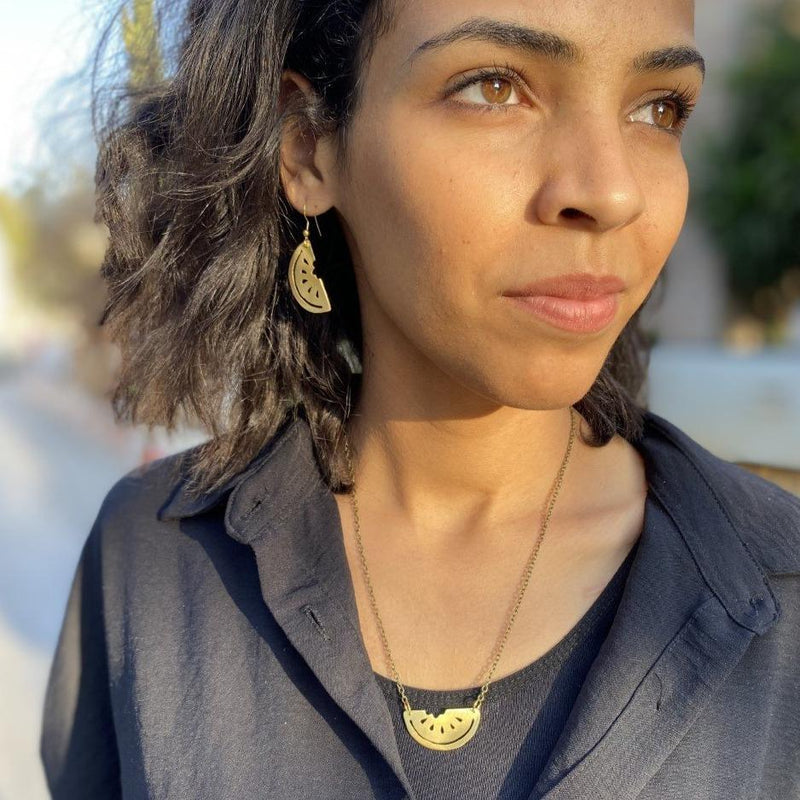
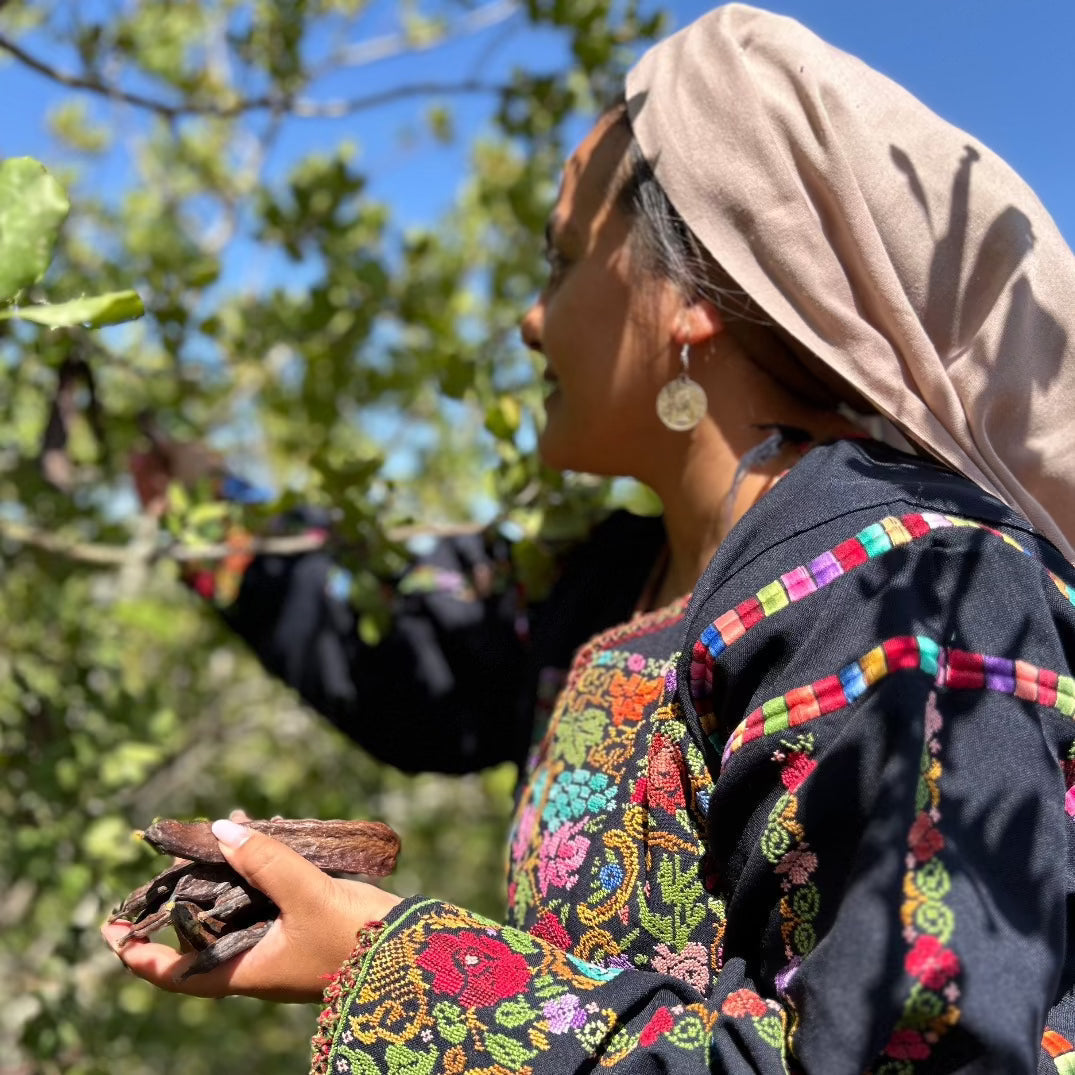
Today, the watermelon appears in Palestinian art, fashion, jewelry, protest, and everyday life as a mark of identity and solidarity. It is embroidered into tatreez pieces. It is carved into olive wood. It appears on keffiyehs, on ceramics, on tote bags, posters, and murals. And it is made into jewelry, wearable expressions of Palestinian identity that can be carried anywhere in the world.
The Watermelon Necklace: Wearing Palestinian Identity
At Handmade Palestine, our watermelon necklaces are made by Palestinian artisans small, beautiful pieces that carry the full weight of the symbol's history in a wearable form.
A watermelon necklace is not a fashion accessory. It is a statement quiet enough to wear every day, clear enough to be immediately understood by anyone who knows what it means. For Palestinians in diaspora, it is a way of carrying identity with them in a world that often tries to make Palestinian identity invisible. For solidarity supporters, it is a visible, wearable expression of where they stand.
When you buy a watermelon necklace from Handmade Palestine, you are paying a Palestinian artisan directly for their work, sustaining their livelihood and their craft, and you are wearing a symbol whose story is worth knowing and worth sharing.
The Watermelon and the Question of Censorship
One of the most striking aspects of the watermelon symbol's recent history is how it has been treated in online spaces. Since October 2023, numerous reports have emerged of social media platforms suppressing or restricting content that includes Palestinian flags or explicit expressions of Palestinian solidarity. In response, many people began using the watermelon emoji as a substitute, exactly as Palestinians in the occupied territories used the watermelon image in the 1960s and 1970s.
The parallel is not lost on Palestinians. The watermelon was born as a response to censorship. Decades later, it is performing the same function in digital spaces. The symbol that emerged from one form of suppression has proved resilient enough to navigate another.
This history gives the watermelon a particular resonance as a symbol. It is not just a representation of Palestinian identity; it is a representation of Palestinian creativity and persistence in the face of attempts to silence that identity. Every time the watermelon reappears in a new context on a protest sign, in a gallery, as a necklace, as an emoji, it carries this history with it.
How to Wear the Watermelon With Meaning
Wearing a watermelon symbol, whether as jewelry, on clothing, or as a tattoo, is most meaningful when it comes with an understanding of what it represents.
The watermelon is not simply a colorful image. It is a symbol with a specific history rooted in Palestinian resistance to occupation and censorship. Wearing it as an expression of solidarity means knowing that history and being willing to share it when asked.
It also means, ideally, wearing a watermelon that was made by Palestinian hands so that the act of solidarity extends beyond the symbol itself to support the real people whose identity the symbol represents.
At Handmade Palestine, every piece we make comes with a story. The watermelon necklaces in our collection are made by Palestinian artisans who know exactly what the symbol means because it is their symbol, their history, and their identity.
Meet the artisans behind Handmade Palestine → Shop watermelon necklaces →
Frequently Asked Questions About the Watermelon Symbol
Q: Why is the watermelon a symbol of Palestine?
A: The watermelon became a Palestinian symbol in the years after 1967, when Israeli military authorities prohibited the public display of the Palestinian flag in the occupied territories. Palestinians began displaying watermelons as a visual substitute; a cut watermelon shows the four colors of the Palestinian flag (red, white, green, black). The symbol has persisted and deepened in meaning ever since.
Q: What do the colors of the watermelon represent?
A: The four colors of a watermelon slice red flesh, white rind, green skin, black seeds correspond to the four colors of the Palestinian flag. Red, white, green, and black have been the colors of Palestinian national identity for over a century.
Q: When did the watermelon emoji become a symbol of Palestinian solidarity?
A: The watermelon emoji 🍉 gained widespread use as a Palestinian solidarity symbol, particularly after October 2023, when many people began using it as an alternative to explicit Palestinian flag references in online spaces where Palestinian content was being suppressed or restricted. The parallel to the original use of the watermelon symbol in the 1960s and 1970s has been widely noted.
Q: Is wearing a watermelon necklace a political statement?
A: The watermelon is a symbol with a specific political history; it emerged from Palestinian resistance to the prohibition of the Palestinian flag. Wearing it is an expression of Palestinian identity or solidarity with Palestinians. Whether that feels "political" depends on your perspective. For Palestinians, expressing their identity is not optional; it is simply who they are.
Q: Where can I buy a watermelon necklace made by Palestinian artisans?
A: Handmade Palestine offers watermelon necklaces made by Palestinian artisans. Every purchase pays the artisan directly and supports Palestinian craft traditions. Shop watermelon necklaces →


Leave a comment
This site is protected by hCaptcha and the hCaptcha Privacy Policy and Terms of Service apply.