
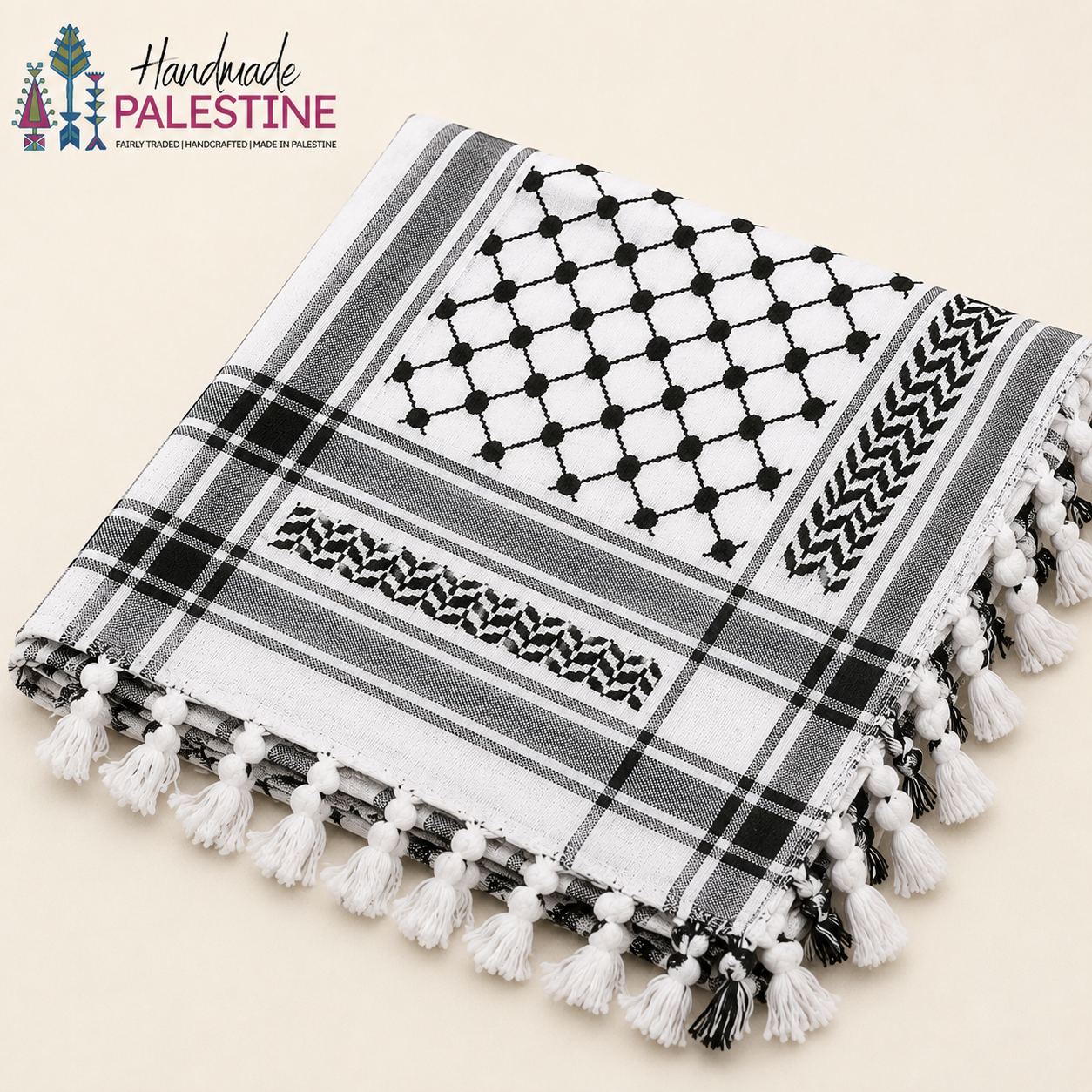
Keffiyeh vs Kufiya vs Shemagh: What Is the Difference?
If you have spent any time researching the Palestinian keffiyeh, you have almost certainly encountered several different names for what appears to be the same garment. Keffiyeh. Kufiya. Shemagh. Hatta. Ghutrah. They all seem to refer to a square cotton headscarf with a distinctive woven pattern — so are they the same thing? And if not, what is actually different?
The answer matters — not just for accuracy, but because these names carry different cultural histories, different regional identities, and different political meanings. Using the right name in the right context is a form of respect.
This guide explains exactly what each term means, where it comes from, and how to use it correctly.
They All Refer to the Same Style of Garment — But Context Matters

The first thing to understand is that keffiyeh, kufiya, hatta, shemagh, and ghutrah all refer to variations of the same traditional Middle Eastern headscarf — a large square of woven cotton fabric, typically worn over the head or around the neck. The basic garment is the same across the region.
Keffiyeh and kufiya are two spellings of the same Arabic word and are used interchangeably — both are Palestinian terms. Hatta is also used within Palestine alongside kufiya and keffiyeh. Shemagh and ghutrah, however, carry distinct regional identities — primarily Jordanian, Gulf, and military contexts — and come with their own visual traditions. Understanding these distinctions is a form of cultural respect.
Keffiyeh and Kufiya — Two Spellings, One Word
Keffiyeh and kufiya are not two different terms — they are two different ways of spelling and pronouncing the same Arabic word: كوفية (kūfiyya). Both refer to the same Palestinian garment, and Palestinians use them interchangeably. When speaking Arabic, Palestinians say kufiya; when writing or speaking in English for an international audience, keffiyeh is the most widely recognized spelling.
You will also encounter other spellings — kufiyeh, kefiyeh, kaffiyeh, koufiyya — all of which are transliterations of the same Arabic word. None of these is more correct than another; they simply reflect different conventions for writing Arabic sounds in English.
The word itself comes from the Arabic كوفية (kūfiyya), with roots that some trace to the city of Kufa in present-day Iraq, though the garment's history in Palestine goes back centuries independently of this etymology.
The kuffiyeh, as worn in Palestine, is traditionally black and white — the pattern that has become globally associated with Palestinian identity and solidarity. The black-and-white color combination carries deep symbolic weight that is specific to Palestine.
At Handmade Palestine, we use "keffiyeh" in our international-facing descriptions because it is the most searchable English term, and "kufiya" when speaking in Palestinian contexts — but they refer to the same garment, and we use them interchangeably.
Shemagh — The Gulf and Jordanian Term
Shemagh is the term most commonly used in Jordan, Saudi Arabia, Iraq, and across much of the Gulf region. It refers to the same style of square woven headscarf but carries its own distinct regional tradition and identity.
The most visually notable difference is color. While the Palestinian kufiya is most traditionally black and white, the shemagh is most commonly red and white — a color combination associated with Jordanian and Gulf heritage rather than Palestinian identity. The red-and-white shemagh is part of the traditional dress of Jordan and has been adopted into military uniforms across several countries.
The shemagh is also widely known in Western military contexts — it was adopted by British and American soldiers for practical use in desert environments during conflicts in the Middle East, and is sold in army surplus stores across Europe and North America under this name.
It is important to understand that while a shemagh and a Palestinian kufiya look similar and share the same basic form, they are not the same culturally. Calling a Palestinian kufiya a shemagh, or calling a Jordanian red-and-white shemagh a Palestinian keffiyeh, flattens real cultural distinctions that matter to the people they belong to.
When to use it: "Shemagh" is the correct term for the red-and-white headscarf associated with Jordanian and Gulf traditions, or when referring to the garment in a Gulf regional context.
Hatta — A Term Used Across the Region, Including Palestine
Hatta is another name for the same headscarf — and importantly, it is not exclusively a Gulf term. Many Palestinians use the word hatta and have always done so. In some Palestinian families and communities, hatta is the primary word for this garment — some people who grew up calling it a hatta may not even be familiar with the word keffiyeh.
The origins of the term are not entirely clear. It may have roots in Gulf usage, but its presence in Palestinian everyday language is real and longstanding. If someone in Palestine calls it a hatta, that is as valid and authentic as calling it a kufiya.
In short, hatta, kufiya, and keffiyeh can all refer to the same Palestinian garment, depending on who you are speaking with and where they are from.
Ghutrah — The White Variant
Ghutrah refers specifically to the plain white version of the headscarf worn in Saudi Arabia and parts of the Gulf. Unlike the patterned kufiya or shemagh, the ghutrah is typically solid white and is worn with a black agal (the doubled cord that holds the headscarf in place). It is a formal garment associated with Gulf dress tradition and has no direct connection to the Palestinian kufiya.
When to use it: "Ghutrah" refers specifically to the plain white Gulf headscarf and is not used in a Palestinian context.
Why the Black-and-White Pattern Matters
Of all the color combinations associated with these headscarves across the region, the black-and-white pattern is the one most deeply associated with Palestinian identity — and this association is not accidental.
The black-and-white kufiya became a symbol of Palestinian national identity during the Great Arab Revolt of the 1930s, when Palestinian farmers and peasants — who already wore it as part of their traditional daily dress — began using it to cover their faces as they resisted British colonial rule. From there, it became inseparable from the Palestinian national movement and spread across the globe as a symbol of Palestinian resistance and solidarity.
Today, when someone wears a black-and-white keffiyeh, the association with Palestine is immediate and widely understood across cultures. This is why it matters where your keffiyeh comes from — wearing the symbol of Palestinian identity while purchasing a mass-produced imitation that sends no money to Palestinians is a contradiction that the kufiya's history does not deserve.
Read more about why buying a keffiyeh made by Palestinian artisans matters →
Red-and-White vs Black-and-White: A Quick Reference
The black-and-white pattern is primarily associated with Palestinian identity and is most commonly referred to as a kufiya or keffiyeh. It is a Palestinian national symbol with deep roots in resistance and solidarity, and it comes from Palestine.
The red-and-white pattern, on the other hand, is most commonly referred to as a shemagh and is associated with Jordanian and Gulf heritage. It has its own distinct cultural tradition and has been widely adopted in military contexts across the region and beyond.
Both are legitimate traditional garments with their own cultural histories. Neither is more or less valid than the other — but they are not the same, and the distinction matters.
What About the Term "Palestinian Shemagh"?
You will sometimes see the term "Palestinian shemagh" used online — often on shopping sites selling keffiyehs to international buyers. This is technically a misnomer. The shemagh is a Jordanian and Gulf term; the Palestinian term for the garment is kufiya or keffiyeh.
The use of "Palestinian shemagh" has spread largely because "shemagh" is well known in Western markets through military usage, and sellers sometimes combine it with "Palestinian" to signal the black-and-white color. But for Palestinians, the garment is a kufiya — not a shemagh.
At Handmade Palestine, we refer to our garment as a keffiyeh (for international audiences) and a kufiya (in Palestinian contexts). We do not use the term shemagh for our Palestinian garments.
A Note on Solidarity and Language
The words we use to describe the kufiya are not just semantic. Choosing to use the Palestinian term — kufiya — when speaking with or about Palestinians is a small but meaningful act of respect. It acknowledges that this garment has a specific home, a specific people, and a specific name.
Wearing a kufiya in solidarity means more when it comes with an understanding of what you are wearing and what it is called by the people whose heritage it carries. At Handmade Palestine, we believe that solidarity is deepened by knowledge — and we hope this guide contributes to that.
Shop our Palestinian keffiyeh collection →
Frequently Asked Questions
Q: Is a keffiyeh the same as a shemagh?
A: They share the same basic form — a large square woven cotton headscarf —, but they are not the same culturally. Keffiyeh (or kufiya) is the Palestinian term; shemagh is most commonly used in Jordan and the Gulf region. The black-and-white pattern is Palestinian; the red-and-white pattern is most associated with Jordanian and Gulf tradition.
Q: What do Palestinians call the keffiyeh?
A: Palestinians use several terms interchangeably — kufiya (كوفية), keffiyeh, and hatta are all used within Palestine depending on the person, family, and region. Kufiya is the Arabic pronunciation; keffiyeh is the most widely recognized English spelling of the same word. Some Palestinians primarily use hatta and may not use the word keffiyeh at all. All are valid Palestinian terms for the same garment.
Q: Why is the keffiyeh associated with Palestine specifically?
A: The black-and-white kufiya became a symbol of Palestinian national identity during the Great Arab Revolt of the 1930s, when Palestinian farmers and peasants used it to cover their faces while resisting British colonial rule. This history of ordinary people wearing their traditional garment as an act of resistance is what gives the Palestinian kufiya its particular meaning globally.
Q: Is it disrespectful to call a Palestinian keffiyeh a shemagh?
A: It is not disrespectful in the sense of being offensive, but it is inaccurate — and inaccuracy in this context matters. Shemagh is a Jordanian and Gulf term with its own distinct cultural tradition. The Palestinian garment has its own name: kufiya. Using the correct term is a form of cultural respect.
Q: Can I wear a keffiyeh if I am not Palestinian?
A: Wearing a kuffiyeh in solidarity with Palestinians — while understanding its history and ensuring yours was made by Palestinian artisans — is widely understood as an act of support rather than appropriation. What matters most is the intent behind wearing it, the knowledge with which you wear it, and whether your purchase directly benefits Palestinians.
Written by Morgan Totah
Visit author's website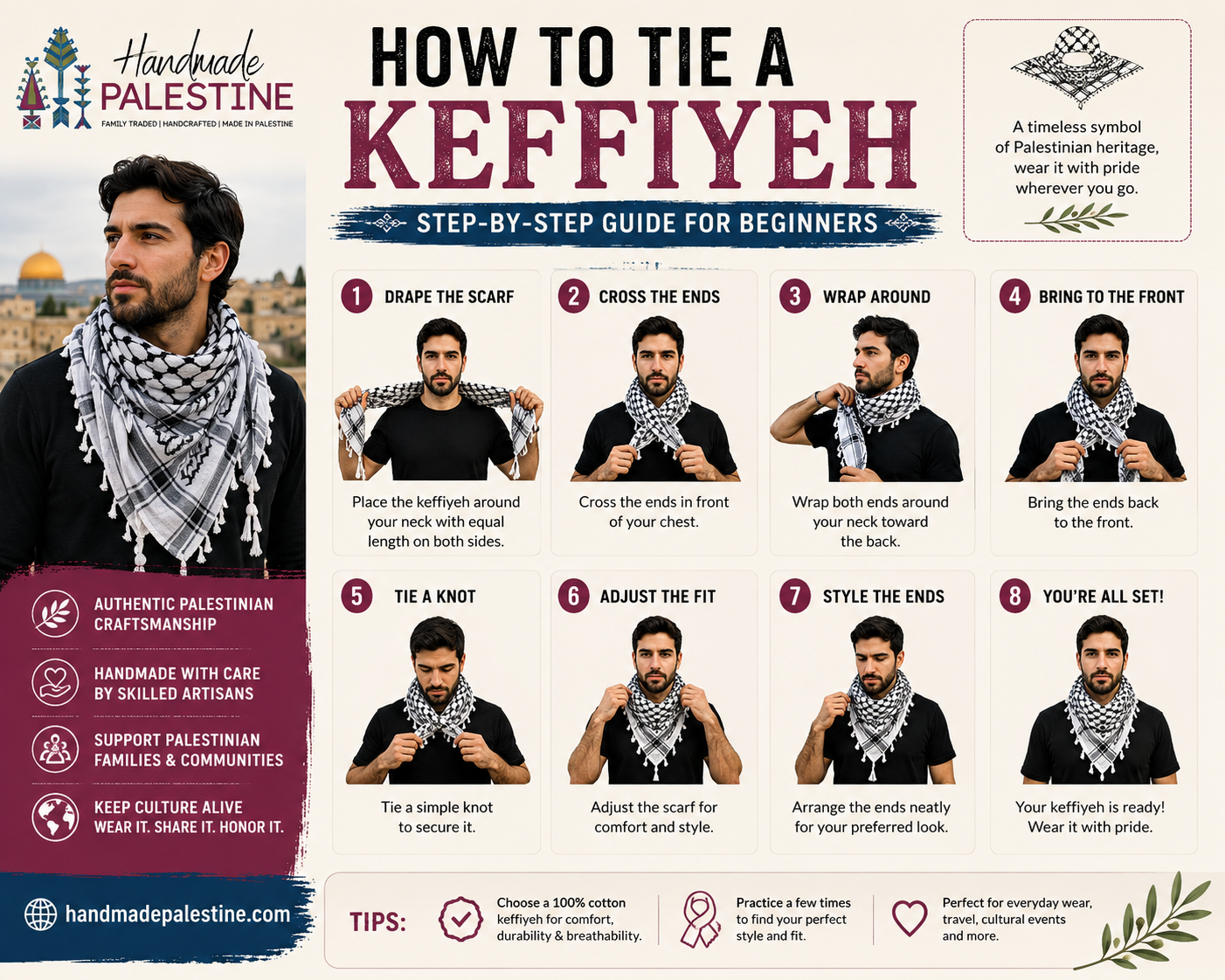


Leave a comment
This site is protected by hCaptcha and the hCaptcha Privacy Policy and Terms of Service apply.