
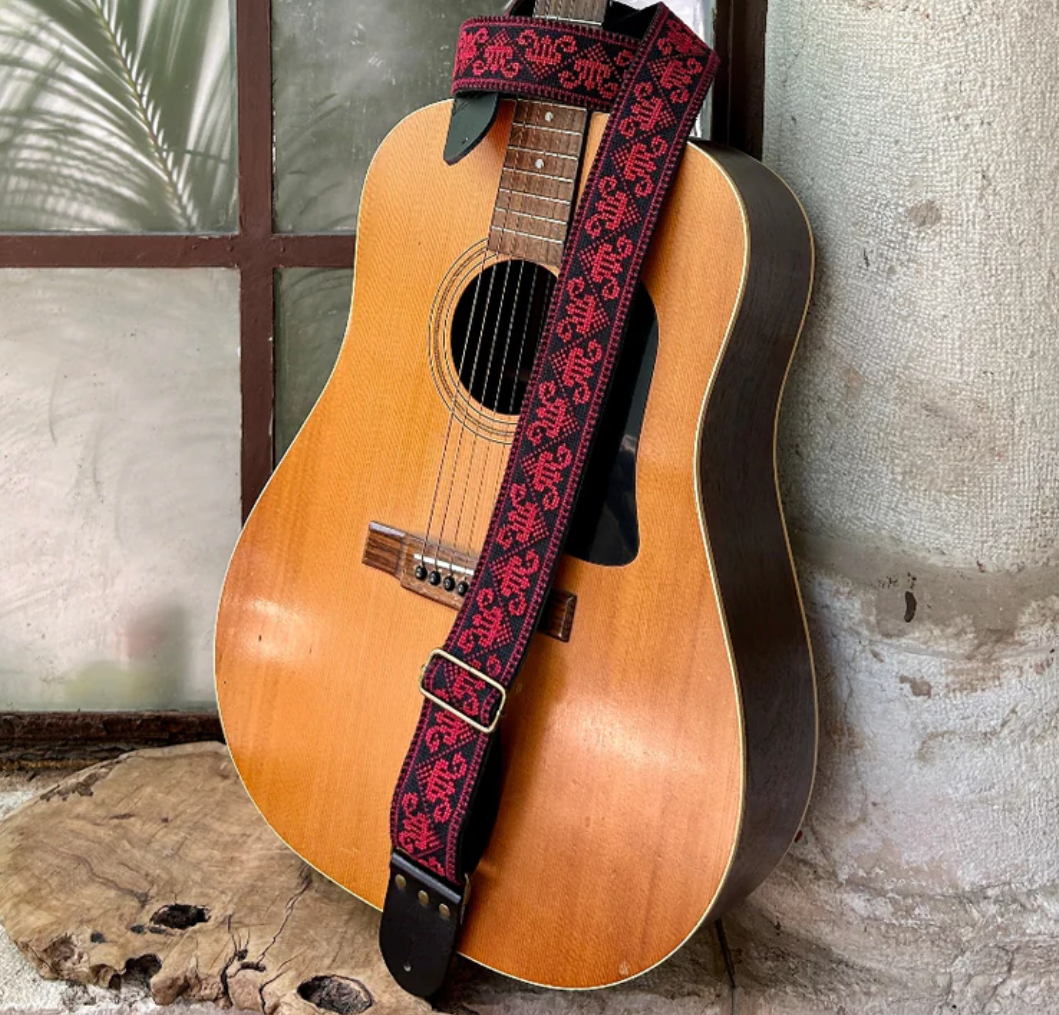
Two Crafts, One Strap: The Story Behind Our Palestinian Guitar Straps
Our Palestinian guitar straps are not made in one place, or by one pair of hands. They are the product of a collaboration between two workshops in two different cities — and of a journey that crosses checkpoints, travels by public bus, and passes through the kind of obstacles that most supply chains never have to think about.
The tatreez embroidery is made by the women of Manjel Ma'qoud in villages around Ramallah. The leather work is done by the artisans of SG Leathers near the old city of Hebron. Between those two cities, the strap travels. And that journey is part of what it is.
The Embroidery: Manjel Ma'qoud
Manjel Ma'qoud is a cooperative of up to 80 women based in and around Ramallah, working in the tradition of tatreez — Palestinian cross-stitch embroidery that encodes village identity, family heritage, and regional belonging in thread and pattern.
What makes Manjel Ma'qoud's model distinctive is how the work reaches the women who do it. The project manager sources all the threads, fabrics, and materials needed for each commission, then sends them out by public transportation to a community leader, a woman in one home village, who sends it on to the women embroiderers in her community. The women work from home — fitting the embroidery around family life, around curfews and closures, around the rhythms of a life lived under occupation — and send the finished panels back when they are done.
It is a production model built around the reality of Palestinian life rather than against it. The embroidery panels for the guitar straps are stitched this way: in kitchens and sitting rooms across the villages around Ramallah, in the vivid reds and deep blacks of the traditional Ramallah tatreez pattern.
The Leather: SG Leathers, Hebron
Once the embroidered panels are completed and returned to Ramallah, they travel south to Hebron — a journey that, in any normal geography, would take around one hour. In the West Bank, it means Israeli checkpoints, gates, permits, and engineered unpredictability.
In Hebron's old city, SG Leathers — an artist-founded workshop with deep roots in the city's centuries-old leather trade — takes the tatreez panels and builds them into straps. The leather they use is durable and carefully finished and locally sourced; the hardware is chosen for longevity. Each strap is made to be used, not displayed.
After the leather work is complete, the straps travel back north to us to be inspected and packaged for you.
A Strap That Has Already Travelled
By the time a guitar strap from Handmade Palestine reaches you, it has already crossed multiple checkpoints, been carried on public buses, passed through the hands of a project manager, women working at home, and leather artisans in a 500-year-old craft quarter. It has navigated the particular friction of producing anything across the fragmented geography of the West Bank.
We think that is worth knowing. Not as a burden — the strap is beautiful and it works — but as a context. The objects we carry are not just handmade. They are made under specific conditions, by specific people, in a specific place. The guitar strap carries all of that with it.
Written by Morgan Totah
Visit author's website


Leave a comment
This site is protected by hCaptcha and the hCaptcha Privacy Policy and Terms of Service apply.