
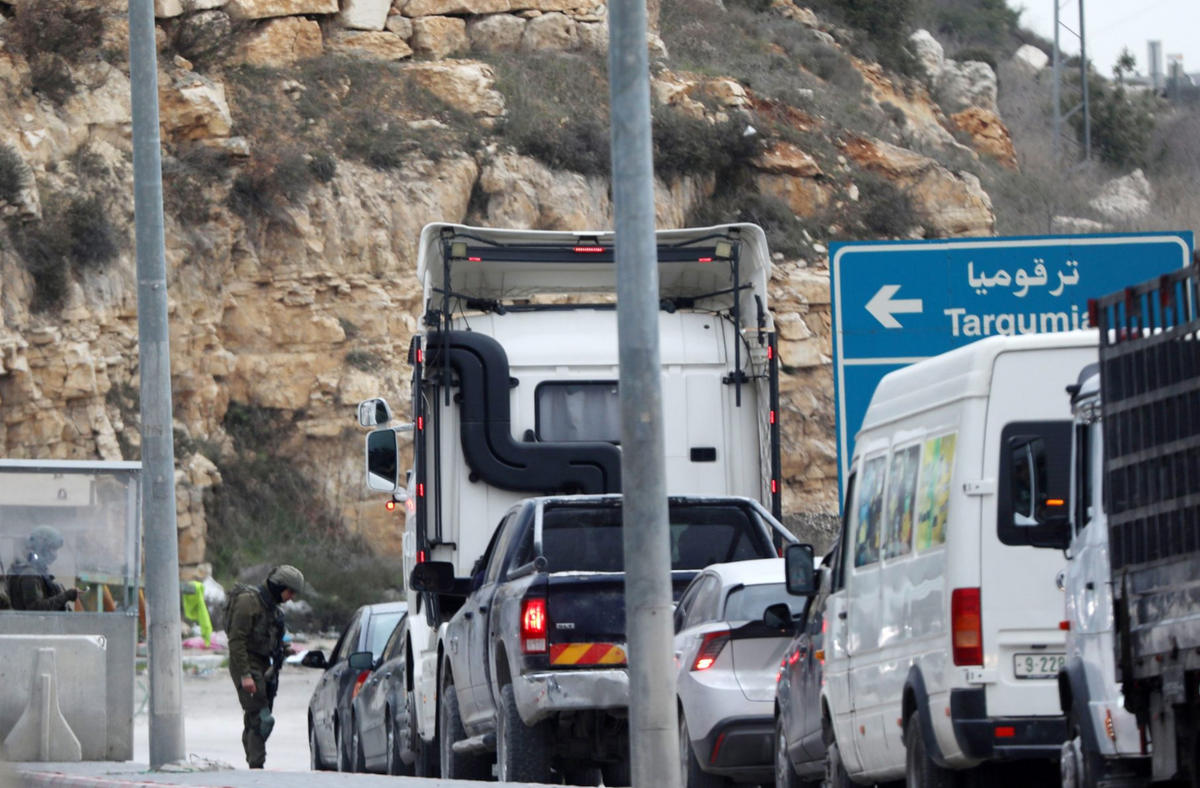
To Bethlehem: A Journey That Should Take 45 Minutes
The drive from Ramallah to Bethlehem normally takes around 45 minutes.
Last weekend, it took me four hours on way. Yesterday, it took five. We were trying to get to a funeral in Beit Sahour, just next to Bethlehem. We had to pick the children up from school and leave Ramallah around 1:30 p.m. to try to make it there by 7:00 p.m.

Before leaving, we called around to find out what was happening on the roads. We considered public transportation, private taxis and the different routes out of Ramallah. In the end, we decided to try DCO.
DCO used to be a diplomatic checkpoint. It is now open to everyone entering and leaving Ramallah, but only until 4:00 p.m. We arrived at around 2:00 p.m. The line was completely stationary. We sat there for more than an hour. The only movement we saw was when one car gave up, made a U-turn and left.
At around 3:20 p.m., the first car was allowed through. Then another car was allowed through every 15 to 20 minutes. We watched the clock. At 3:57 p.m., three minutes before closing, the last car was allowed through.
At exactly 4:00 p.m., three soldiers came out, closed the large yellow gate and locked it. Every car that was still waiting turned around and left.
The checkpoint had been officially open until 4:00 p.m., but the way traffic was being processed meant that almost nobody could actually get through. We eventually turned around and drove nearly an hour north before heading south again and approaching the area from another direction. This is what a trip between Palestinian cities can look like now.
And this isn't just happening to people trying to attend a funeral. Over the weekend, I spoke with artisans in Beit Sahour, Beit Jala, Bethlehem and Hebron. What I heard repeatedly was how difficult it has become simply to get to work and move around.
One artisan told me that a journey that used to take five minutes now requires leaving home at 5:00 a.m. It can take more than an hour, and there is still no guarantee that the route will be open or that they will be able to pass without being stopped.
People are constantly trying to work out which roads they can use.
Is the road open today?
Is there a checkpoint?
Are soldiers there?
Are they letting people through?
Are settlers blocking the road?
How long will it take?
Will the situation change while you're on the road?
Can I get back home?
There isn't a reliable schedule that people can plan their lives around.
Imagine sitting at a checkpoint where the light is red. You wait because you understood that you are not supposed to go through. The soldiers ignore you for around ten minutes. Eventually, you slowly start driving forward because there is no indication of what you are supposed to do. Even then, you are worried about being shouted at or stopped. These aren't unusual situations. And that red light that you are actually meant to go through can be used to justify your death.
Watch Handmade Palestine founder Morgan Cooper Totah journey from Bethlehem to Hebron to visit artisans recently here
People live in one place and work in another. Children go to school in another city. Doctors, dentists, parents, grandparents and other family members may all live in different villages or cities. Palestinians don't live their lives within one small area. They need to move between communities.
So when roads are closed, checkpoints are delayed or access changes without warning, it affects almost every part of daily life.
It affects when someone leaves for work.
It affects when children get home from school.
It affects whether someone can make a medical appointment.
It affects whether someone can visit their family.
It affects whether someone can get to a funeral.
It affects businesses because employees and customers cannot always get where they need to go.
And it affects artisans in particular because many of them depend on being able to move between their homes, workshops, suppliers, customers and markets.
The conversations over this weekend were different from the frustration I have heard for a long time. There is a lot of despair. Some artisans are talking about leaving Palestine. Some are actively looking into immigration. People who have spent years building their businesses and supporting their families are questioning whether they can continue doing that under these conditions.
This is important because it is easy to talk about restrictions on movement as a political or logistical issue. But the practical reality is much simpler. People can't reliably get from one place to another. And that affects their ability to live and work.
It also isn't only about essential travel. People should be able to visit family on a weekend. They should be able to drive into the mountains, go to the Dead Sea, have a family gathering or visit friends without having to plan their day around whether a checkpoint will be open. That is part of having a normal life.
What happened to us yesterday was one journey. We eventually made it to Bethlehem. The reason I am writing about it is because this is happening every day to people who don't have the option of simply turning around and trying another route. For many Palestinians, this is not an occasional inconvenience. It is part of getting to work.
Getting to school.
Getting to the doctor.
Getting home.
And it is taking a physical and emotional toll.
The people I spoke to are tired. They are frustrated. And increasingly, they are losing hope. This should not be normalized. A 45-minute drive should not take five hours. And getting from one Palestinian city to another should not be something people have to plan their entire day around.

Written by Morgan Totah
Visit author's website


Leave a comment
This site is protected by hCaptcha and the hCaptcha Privacy Policy and Terms of Service apply.