
Why Handmade Is So Relevant: Who Is Actually Supported by Your Purchase?
When buying handmade, it's easy to focus on the finished product: the colours, the details and the craftsmanship. But there's another part of the story that deserves just as much attention: the people behind it.
Who actually made it? Who benefits from your purchase? And how much of the money you spend reaches the people whose hands created it? These questions are particularly important when buying Palestinian products, where supporting local businesses and preserving traditional craftsmanship are often part of the reason we choose to buy.
But not all products, or business models, have the same impact.
Handmade vs machine embroidery: Why the distinction matters
There is absolutely nothing wrong with machine embroidery. It makes traditional designs more accessible and allows women to enjoy beautiful embroidered thobes and dresses for weddings and special occasions without the expense of hours of handwork. But the two methods offer very different employment opportunities.
A machine embroidery operation might provide employment for one person operating the machine.
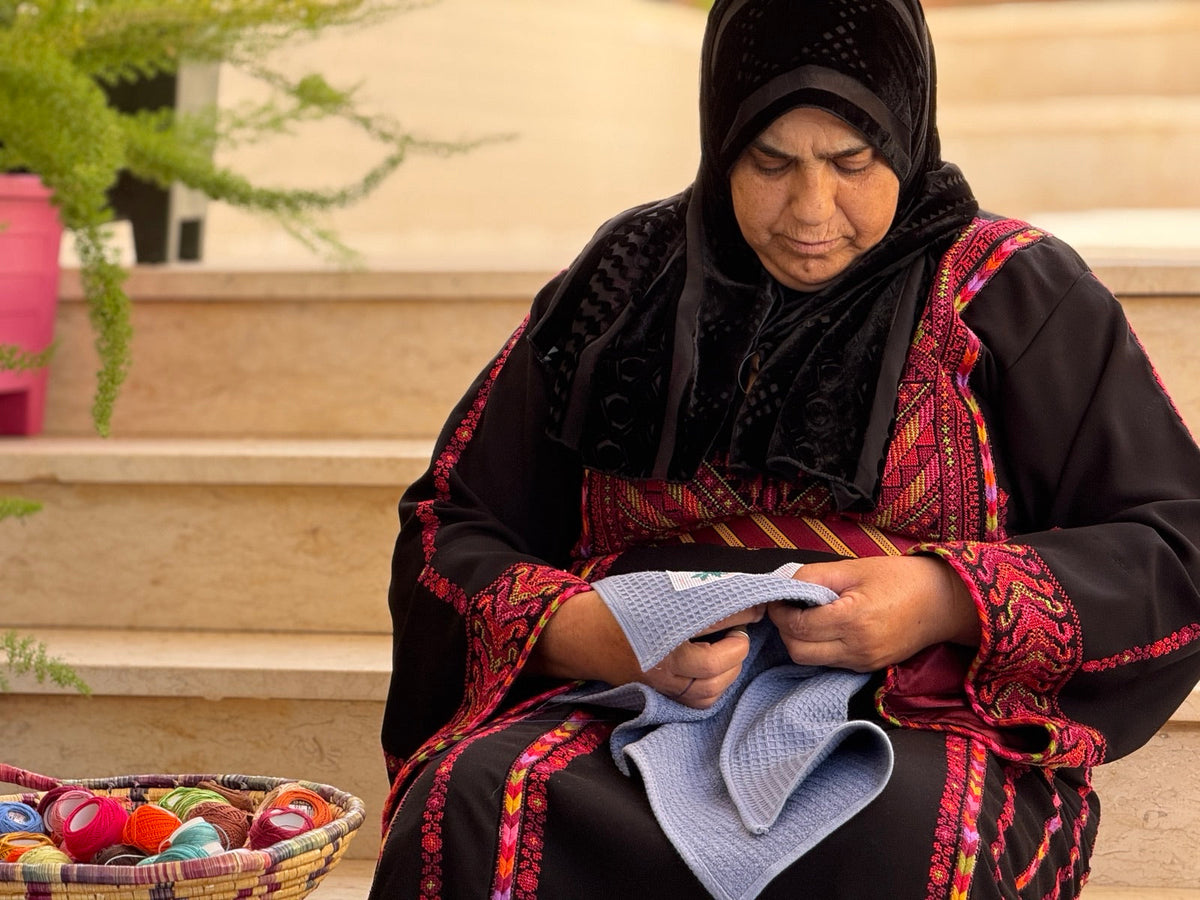
A hand embroidery initiative, particularly one organised around a cooperative or social enterprise model, can create meaningful income opportunities for dozens of women. Our hand embroidery production, for example, supports up to 80 women.
That's 80 women earning through their skills, contributing to their households and helping keep traditional craftsmanship alive. This isn't about saying one method is better than the other. It's about recognizing the difference and understanding what your purchase makes possible.
The true value of handmade
Hand embroidery takes time. Sometimes days or even weeks to complete a single piece. There is also a physical cost that is rarely considered: the strain on a woman's eyes, back, shoulders and fingers, alongside the patience and concentration required to create intricate designs stitch by stitch.
We talk about fair trade and living wages, but are we really prepared to pay what this work is worth?
There is often a disconnect between wanting to support women artisans and being willing to pay for the time and skill involved. We cannot expect handmade products to cost the same as machine-produced alternatives when the labour behind them is so different.
Not everyone can afford handmade, and that's understandable. But if we want these skills and livelihoods to continue, we have to recognize the value of the work rather than expecting women to absorb the difference.
Palestinian-owned doesn't automatically mean ethical
Supporting Palestinian-owned businesses is important, but ownership alone doesn't tell us how a business operates.
A product can be made in Palestine without the women producing it receiving fair compensation. A Palestinian-owned business can still concentrate most of its financial benefits with one person, while the artisans doing the actual work receive very little. Being Palestinian-owned, made in Palestine, or both does not automatically make a business ethical.
It's worth asking who makes the products, how they are paid, how many people benefit and where the money actually goes. This is one reason we believe cooperative and social enterprise models can be so valuable. When genuinely centred around the artisans, they can create opportunities for more women and distribute the benefits of a business more widely.
How we approach handmade
For us, the women behind our products are just as important as the products themselves. Our pieces are hand-embroidered by women who spend hours carefully creating each design, bringing their skills, experience and care to every stitch.
We operate on a fair-trade basis. Our artisans are paid in advance, and we supply all the materials, covering the costs ourselves. They are not expected to invest their own money in supplies or wait for a customer to purchase a finished product before receiving payment for their work.
We believe the financial responsibility of production should sit with the business, not with the women doing the work. Our aim is to create meaningful employment opportunities while ensuring that the women whose skills make these products possible are properly valued and compensated.
So, who benefits from your purchase?
Handmade is about more than owning something unique. It's about recognising the people, skills and livelihoods behind it. A machine can reproduce a beautiful pattern, but it cannot create the same employment opportunities as a model that puts the work directly into the hands of dozens of women. When choosing handmade, look beyond the label. Ask who made it, how they are paid and whether your purchase genuinely makes a difference to their lives.
Because supporting Palestinian craftsmanship should mean more than simply buying something Palestinian. It should mean supporting the people who keep that craftsmanship alive.
Discover handmade tatreez gifts for Christmas
Discover our collection of beautifully intricate, hand-embroidered tatreez pieces, each supporting the women whose skills and labour keep this tradition alive. More than just beautiful gifts and decor, these pieces represent real work, income and livelihoods.
Look beyond the product, choose handmade, support Palestinian women artisans and make sure your purchase puts value back into the hands of the people who create it.




Leave a comment
This site is protected by hCaptcha and the hCaptcha Privacy Policy and Terms of Service apply.