
The Story of Dawud’s Mother’s Tree: The Story of Every Palestinian
This is a story that begins with memory, but it is not held safely in the past. It continues—daily, quietly, painfully—in the lives of Palestinians scattered across the world.
It is the story of Dawud's mother. A few moths ago Dawud reach out to us on email asking for help making an olive wood ornament that he would give to his mother's family and friends when she passed. She was in hospice at the time and he wanted to hand those who would mourn her a piece of Palestine to remind them of her kindness and love. His mother's story moved me deeply.
"My mother was born in Kifr Birem, in the north near the Lebanese border in the upper Galilee. The name of her village—Kifr Birem—has travelled with her longer than many homes last in reality. It has remained on her Canadian passport since we became citizens in 1977. A line of ink that somehow carries both identity and loss.
"She has returned “home” multiple times. But home, in her case, is a place she can visit and never fully enter in the way she once belonged to it. Each journey carries its own quiet weight—the awareness of what was taken, what remains, and what is no longer permitted to return."
Kifr Birem is one of those Palestinian villages that was forcefully emptied and destroyed after the Nakba, later in 1953. What remains today are fragments: a church, a cemetery, and the memory of a community that once lived there fully, ordinarily, like any other village in the world. Residents were told to leave for security reasons. They were never allowed to come back.
And yet, in the most human way possible, they never actually left.
My mother’s wish is simple, and impossible in the same breath: to be buried there. To return not as a visitor, but as someone who belongs to the soil she was born into. But without citizenship recognition, even death becomes complicated. Even rest has conditions attached to it.
Before the war began, we spoke gently about what the next chapter might look like. Palliative care. A final journey to Haifa. A way of returning while there was still time. But the war came, and with it, borders became harder, routes became uncertain, and even the most carefully held plans began to dissolve.
Air travel changed. Connections became impossible. And what we thought we could prepare for suddenly felt fragile in the face of reality.
So we found another path.
With the kindness of the church in Kifr Birem, special permission was given for what comes next: for cremation, and for her remains to one day be interred in the cemetery in Kifr Birem. I will make that journey when it is possible again. When the world allows movement to match intention. When grief can finally travel without obstruction.
And when that day comes, we will also do something we have done before.
We will plant another olive tree.
Because some things need to grow when everything else feels interrupted.
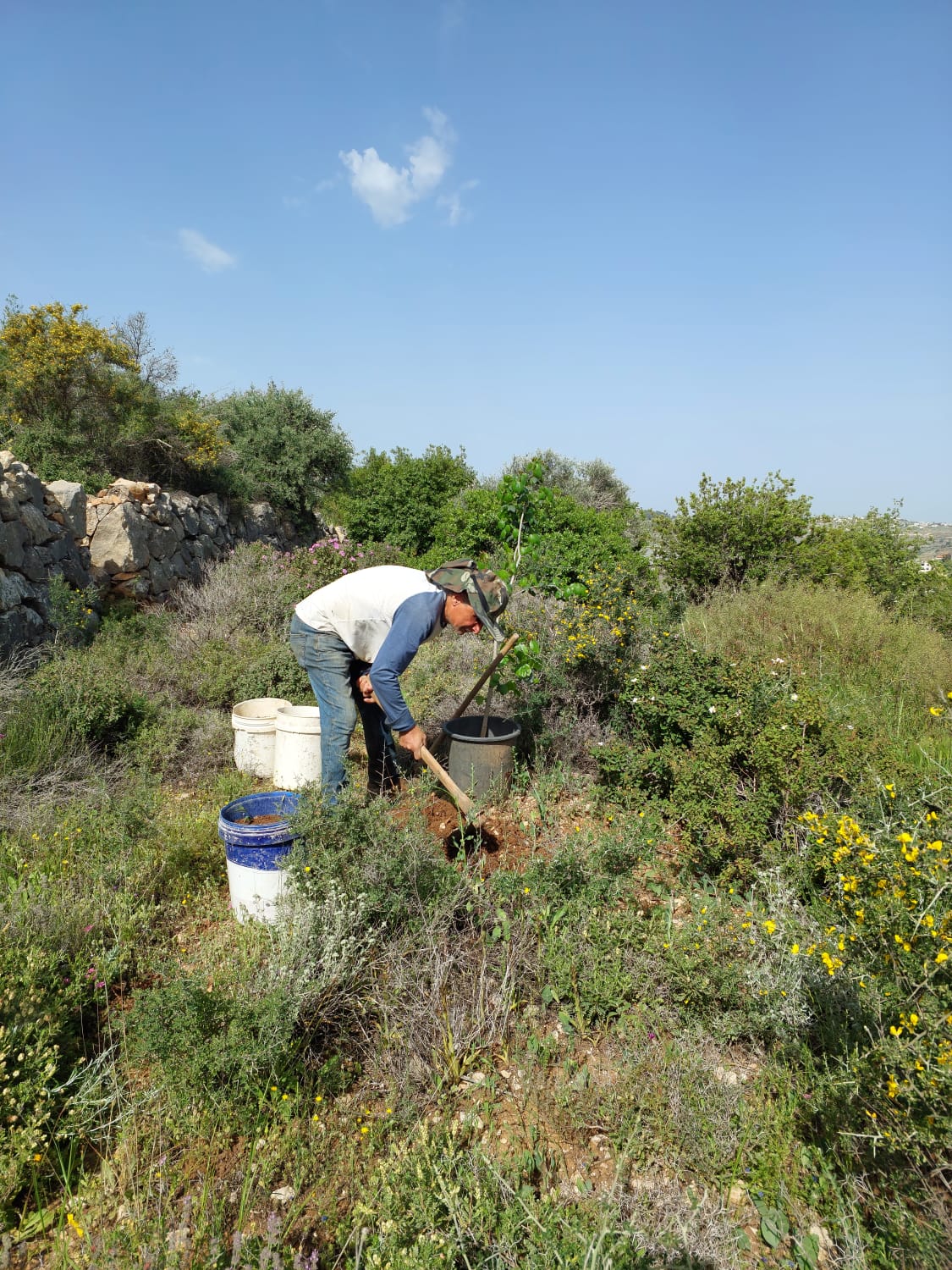
When I read this story, I wept. My husband came home and I shared it with him. It is the story of every Palestinian refugee. Being a foreigner and denied the justice of coming home. The next day my husband went to the land and planted a tree for Dawud's mother.

It was not a symbolic gesture in the distant sense. It was practical, tender, and deeply rooted in something real: a living tree growing in Palestinian soil, carrying a name, carrying love, carrying memory forward in a way that does not depend on borders or permissions. My husband planted a tree that was native to the village of Dawud's mother.
A tree does not rush. It does not forget. It does not ask for proof of belonging. It simply continues.
And perhaps that is why it feels like the most honest response we have.
In dedicating this tree to Dawud's mother, it became more than a gift. It became a form of continuity. A way of saying: you are still here, even in absence. You are still rooted, even when everything else has been uprooted.
In that moment, I realised something simple and difficult at the same time: what people see of Palestine in the world is only the surface. What they rarely see is the inheritance of grief that moves through generations quietly, and the equally quiet resilience that refuses to disappear alongside it.
This is not a story designed to end neatly. It does not resolve. It continues.
But it also holds something steady inside it.
A tree planted in love.
A name carried across borders.
A mother still belonging to a place she couldn’t return to freely.
And a promise that memory will not be left alone.
This is Dawud mother’s tree. And it is also all of ours.
Written by Morgan Totah
Visit author's website


Leave a comment
This site is protected by hCaptcha and the hCaptcha Privacy Policy and Terms of Service apply.