
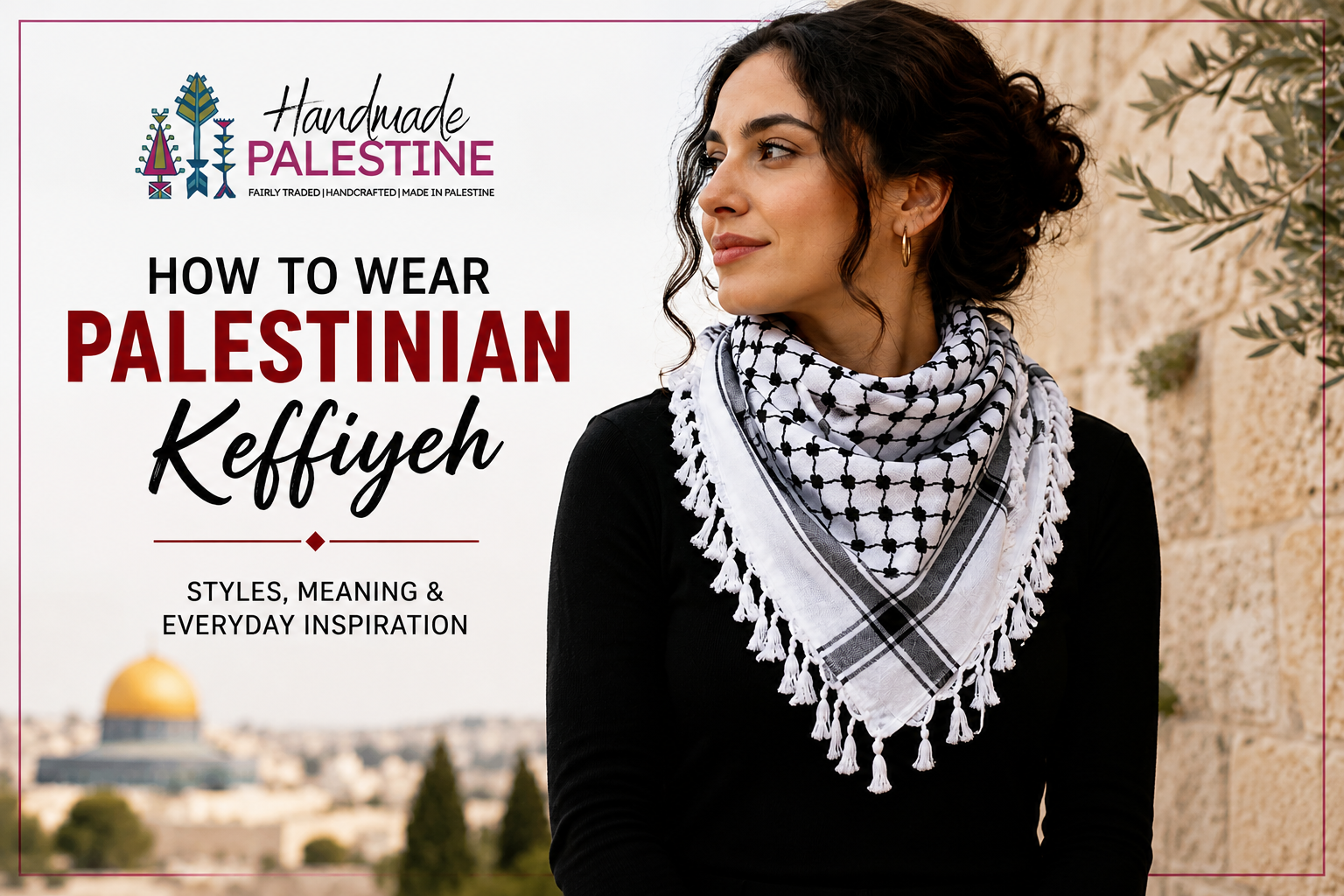
How to Wear a Keffiyeh: 5 Ways to Style Palestine's Iconic Scarf
The Palestinian keffiyeh is one of the most recognizable garments in the world. It has been worn by farmers in the fields of Palestine, by activists on the streets of New York, by grandmothers in refugee camps, and by students on university campuses across the globe. And yet, for many people who hold one in their hands for the first time, the same question comes up immediately: how do I actually wear this?
It is a fair question. The keffiyeh is a large square scarf - typically around 120 cm x 120 cm -and its versatility is both its beauty and its challenge. There is no single correct way to wear it. Different regions, different generations, and different occasions call for different styles.
This guide walks you through five of the most common ways to wear a keffiyeh, including the styles most common in Palestine itself, the most widely worn style internationally, and a few others worth knowing. But before we get into the how, it is worth understanding a little of the why.
Why How You Wear It Matters
The keffiyeh is not just a scarf. It is a piece of Palestinian cultural heritage that carries centuries of history, identity, and meaning. Wearing it is an act - whether you are Palestinian yourself, wearing it in solidarity, or simply drawn to its beauty and story.
Wearing it with awareness of what it represents is the most important thing. And wearing one that was made by Palestinian hands - by the artisans and factory workers whose livelihoods depend on this craft - is what makes your wearing of it a genuine act of support rather than a fashion statement disconnected from its roots.
At Handmade Palestine, every keffiyeh in our collection comes from Palestinian-owned production. Read more about where our keffiyehs come from and why it matters →
With that said — here are five ways to wear it.
Style 1: The Triangle Neck Wrap - The Most Common Everyday Style

This is the style you will see most often, both in Palestine and internationally. It is simple and practical, and the starting point for understanding how the keffiyeh works as a wearable garment.
How to do it:
-
Lay your keffiyeh flat and fold it diagonally to create a triangle. You should have a long folded edge at the top and a single pointed tip at the bottom.
-
Hold the triangle in front of you with the pointed tip facing downward toward your stomach or chest.
-
Bring the scarf up to your neck, holding one end in each hand.
-
Cross the two ends behind your neck.
-
Bring both ends back to the front and let them hang naturally, or tuck them loosely inside the fold.
The result is a clean triangle of fabric sitting at your chest, with the two ends hanging at the front. The embroidered border of the keffiyeh frames the triangle beautifully — which is one of the reasons this style has become so widely worn.
Tips:
-
The heavier and better-made your keffiyeh, the better this style sits. A well-woven Palestinian keffiyeh drapes naturally and holds its shape; a cheap, thin imitation tends to slip and bunch.
-
You can adjust how much of the triangle is visible by pulling the two ends tighter or looser before crossing them at the back.
-
This style works equally well with the black-and-white keffiyeh and the red-and-white version.
Style 2: The Classic Head Drape — The Traditional Palestinian Style

This is the most traditional way to wear a keffiyeh in Palestine, particularly among older generations. It is also the style most associated with Palestinian national identity in its visual iconography - the image of a keffiyeh draped over the head with the ends falling over the shoulders is one of the most recognized images of Palestinian life globally.
In Palestine, you will most often see this style in winter - the keffiyeh draped over the head, with the tip of the triangle hanging down the back and the two sides wrapped around the head and face for warmth and protection from the cold and wind.
How to do it:
-
Fold the keffiyeh diagonally into a triangle.
-
Place it over your head, with the long folded edge sitting across your forehead - roughly at your hairline.
-
Let the single pointed tip hang down your back.
-
The two ends will fall over your shoulders on either side.
-
You can leave the ends loose over your shoulders, or wrap them forward across your chest and tuck them in or tie them loosely at the front.
For added security - particularly outdoors in wind - you can hold the drape in place with an agal, the traditional doubled black cord worn over the keffiyeh in many parts of the Arab world. Without an agal, a gentle tuck or crossing of the ends at the front will keep it in place.
Tips:
-
This style works best with the keffiyeh worn loosely, not pulled tight. The fabric should sit comfortably on your head with some volume.
-
In colder weather, pull the two side ends up around your face for extra warmth - this is the everyday winter style seen across Palestine.
-
This is the style with the deepest cultural meaning. Wearing it this way is a direct connection to the way Palestinian farmers, workers, and families have worn the keffiyeh for generations.
Style 3: The Shoulder Wrap - Relaxed and Everyday

This is perhaps the simplest way to wear a keffiyeh, and one of the most versatile. It requires no folding technique and works as an effortless layer over almost any outfit.
How to do it:
-
Open your keffiyeh fully, or fold it loosely into a large rectangle.
-
Drape it over both shoulders like a shawl, letting it fall evenly on both sides.
-
Let the ends hang at the front, or pull one side longer than the other for an asymmetric look.
That is genuinely it. This style is about presence rather than technique - the keffiyeh's distinctive pattern does the work.
Tips:
-
This style works particularly well in transitional weather - warm enough that you do not need full coverage, cool enough to want a layer.
-
The shoulder wrap is a good first style for someone new to wearing a keffiyeh. It lets the garment speak without requiring any particular technique.
-
It also works beautifully as a table runner, wall hanging, or decorative drape — the keffiyeh is versatile in ways that go well beyond clothing.
Style 4: The Loose Neck Scarf - The Most Widely Adopted International Style

This is the style that spread beyond Palestine and became part of global streetwear and fashion from the 1960s onward - worn by artists, activists, and fashion-conscious people across Europe, North America, and beyond. It is relaxed, wearable with almost anything, and easy to do.
How to do it:
-
Fold the keffiyeh into a long rectangle by folding it in half, then in half again lengthwise.
-
Drape it loosely around your neck, letting both ends hang at the front.
-
Adjust the length and looseness to your preference - some people prefer a longer, looser loop; others prefer it sitting closer to the neck.
Alternatively:
-
Fold the keffiyeh into a triangle.
-
Drape the long folded edge around the back of your neck with the two ends coming to the front.
-
Tie loosely or let hang.
Tips:
-
This style works well over a jacket, coat, or even a light sweater in warmer months.
-
It is the most neutral of the five styles in terms of cultural specificity - the most internationally recognizable way to incorporate the keffiyeh into everyday dress.
-
Even in this simple style, wearing a genuine Palestinian keffiyeh - rather than a mass-produced imitation - makes a difference that is visible in the quality and drape of the fabric.
Style 5: The Turban - Elaborate and Visible

The turban is the most elaborate of the five styles and takes the most practice to get right, but once mastered, it is one of the most striking ways to wear a keffiyeh. It provides full head coverage and works particularly well in hot, sunny conditions - which is exactly the environment the keffiyeh was originally designed for.
How to do it:
-
Fold the keffiyeh into a long rectangle.
-
Hold one end against the side of your head, just above your ear, with several inches of fabric hanging free below your hand.
-
Begin wrapping the long end of the fabric around your head, keeping the wrap snug but not tight.
-
Continue wrapping, overlapping each layer slightly and keeping the fabric flat as you go.
-
Once you have wrapped it around your full head, tuck the remaining end into the wrapped layers to secure it. You can also tie it at the back or knot it loosely at the side.
Tips:
-
The key to a good turban is starting with the fabric lying flat rather than twisted. Take your time on the first wrap.
-
Practice helps significantly - your first attempt will likely feel loose or uneven. By the third or fourth try, the technique becomes natural.
-
This style works especially well outdoors in sun and wind, which is the context in which Palestinian farmers originally wore the keffiyeh as a working garment.
A Note on Wearing the Keffiyeh With Respect
The keffiyeh is a garment that has meant different things to different people at different moments in history. It has been a practical tool, a symbol of resistance, a marker of cultural identity, and an internationally recognized act of solidarity.
However you choose to wear yours, the most meaningful thing you can do is understand what it represents - and ensure that the keffiyeh you wear came from Palestinian hands.
Many keffiyehs sold globally are mass-produced in countries with no connection to Palestine. They carry the visual pattern of the keffiyeh without any of its story, and none of the purchase price reaches a Palestinian artisan or worker.
At Handmade Palestine, our keffiyehs are made by a Palestinian-owned factory - one with deep roots in Palestine, whose workers and owners have kept this craft alive under extraordinary circumstances. Every keffiyeh you buy from us means fair wages paid to the people who made it.
Shop our Palestinian keffiyeh collection →
Frequently Asked Questions About Wearing a Keffiyeh
Q: Which style is most common in Palestine?
A: In everyday life in Palestine, the triangle neck wrap is the most common style for casual wear. In winter, the classic head drape - with the triangle tip hanging down the back and the sides pulled around the face - is widely worn for warmth. Both styles are deeply rooted in Palestinian daily life.
Q: Is there a "right" way to wear a keffiyeh?
A: There is no single correct way. The keffiyeh has always been worn in multiple styles depending on context, weather, and personal preference. What matters more than technique is wearing it with awareness of what it represents.
Q: Can anyone wear a keffiyeh?
A: Wearing a keffiyeh in solidarity with Palestinians - while understanding its history and buying one that directly supports Palestinian artisans - is widely seen as an act of support, not appropriation. What matters most is where your keffiyeh comes from and whether your wearing of it is grounded in knowledge and respect.
Q: How do I keep my keffiyeh in good shape?
A: Hand wash in cool water with a gentle detergent. Avoid wringing or tumble drying - lay flat or hang to dry to preserve the weave and embroidered border. A well-made Palestinian keffiyeh, properly cared for, lasts for years.
Q: What size is a traditional Palestinian keffiyeh?
A: A traditional keffiyeh is a square scarf, typically around 120 cm x 120 cm (approximately 47 inches square). This size is what allows all five of the styles above to work properly - smaller scarves marketed as keffiyehs often cannot achieve the traditional head drape or turban styles.
Written by Morgan Totah
Visit author's website


Leave a comment
This site is protected by hCaptcha and the hCaptcha Privacy Policy and Terms of Service apply.