
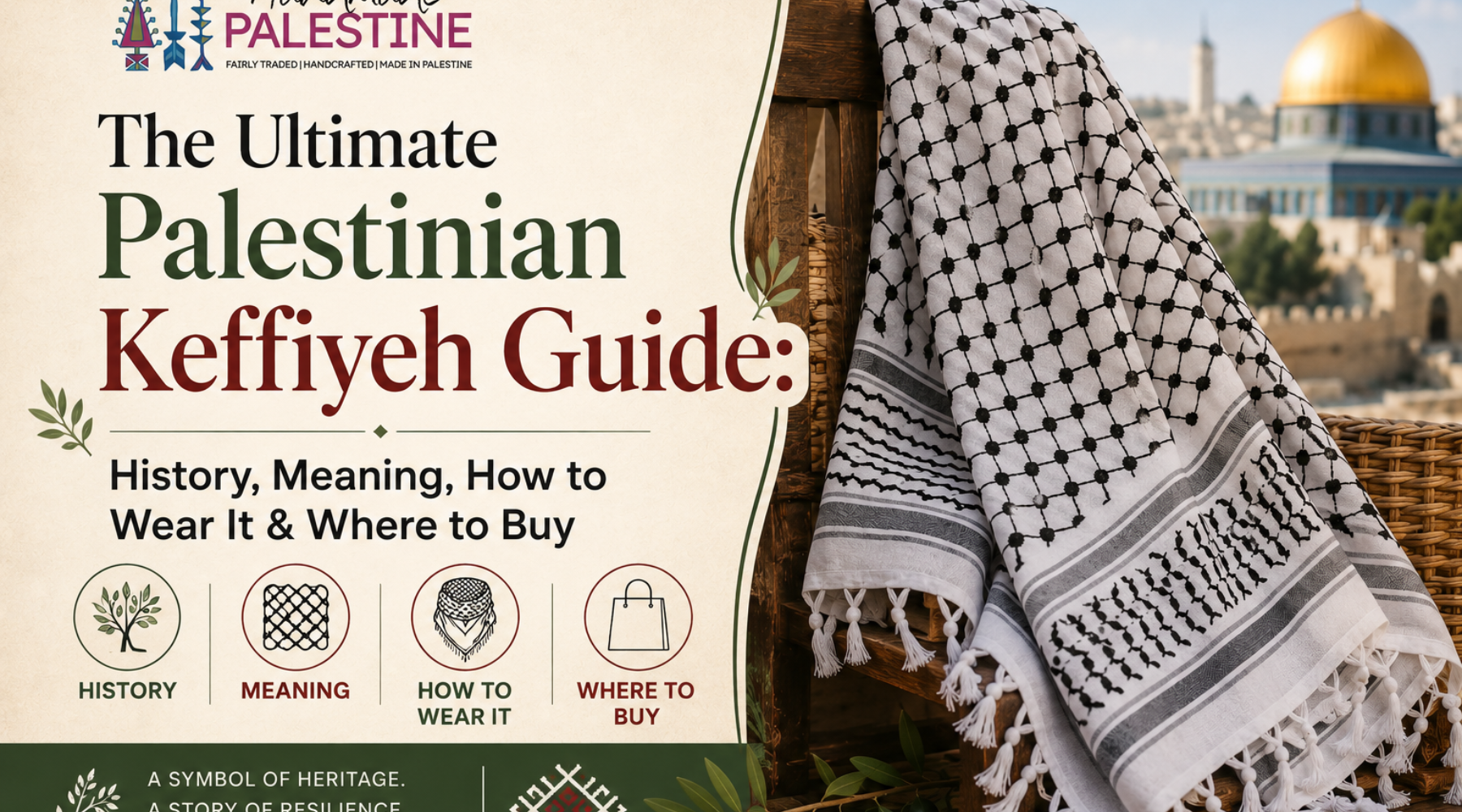
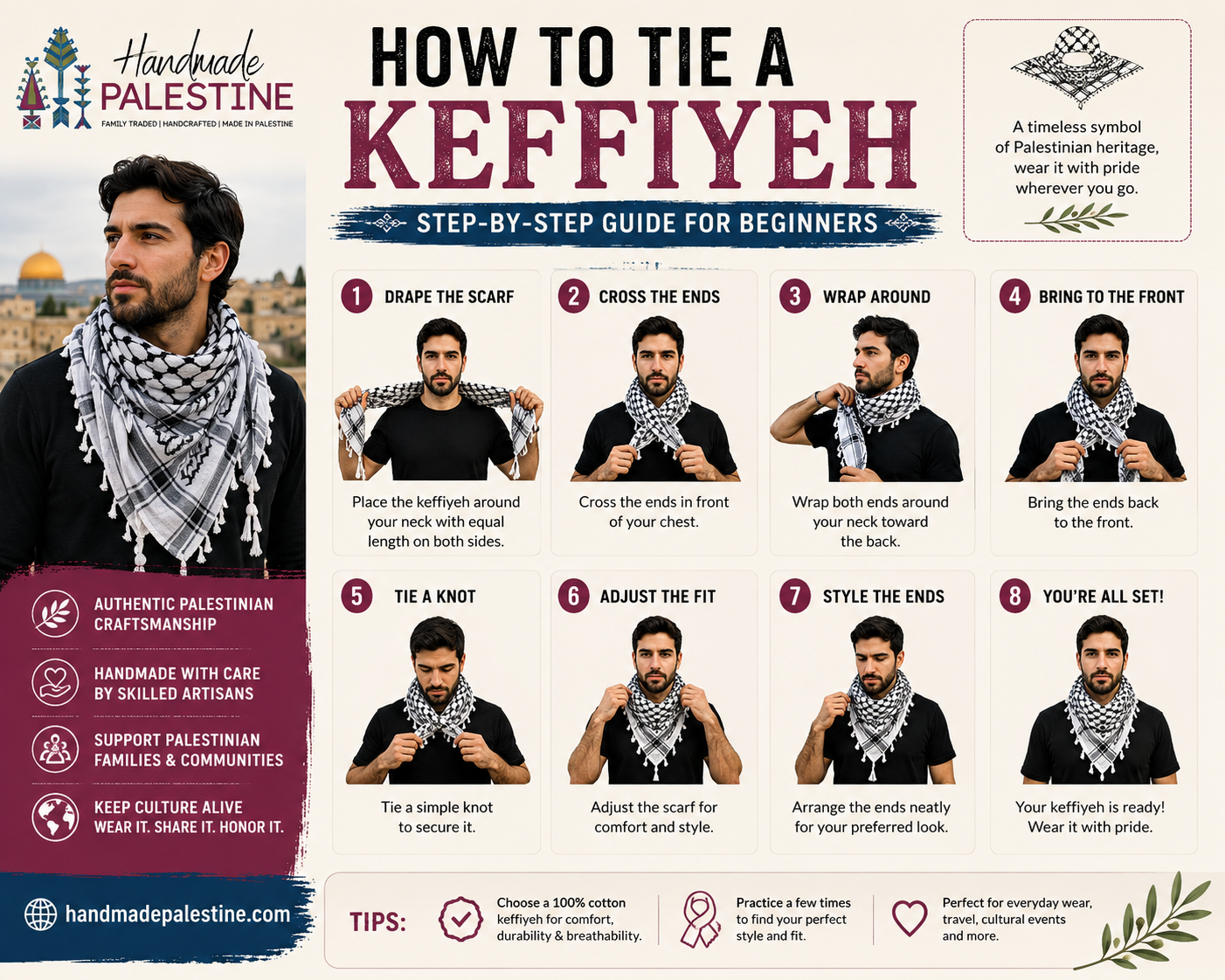
How to Tie a Keffiyeh: Step-by-Step Guide for Beginners
Before anything else, the keffiyeh is not a fashion accessory. It is a symbol of Palestinian identity, resistance, and steadfastness that has been worn by Palestinian farmers, workers, and families for generations. If you are here because you want to wear one in solidarity with Palestinians, that intention matters, and it is the right place to start.
This guide exists to help you wear your keffiyeh with confidence — and with the understanding that how you wear it is inseparable from why you wear it. The keffiyeh's meaning does not change based on which tying style you choose. What matters is that you wear it knowing whose heritage it carries, and that yours was made by Palestinian hands.
With that foundation in mind, here are the most common ways to tie a keffiyeh, step by step.
Before You Start: A Few Things Worth Knowing

Size is standard. A traditional Palestinian keffiyeh is approximately 120 cm x 120 cm (roughly 47 inches square). This is the standard size — it does not vary much, and it is what allows all the tying styles below to work properly.
Weight is a matter of preference, not performance. Palestinian keffiyehs come in lighter and heavier weights. A heavier keffiyeh is warmer and well-suited to winter wear; a lighter one is more comfortable in warmer months. Both will drape and tie in the same ways — the weight you choose is simply a matter of when and where you plan to wear it, not a factor that changes how you tie it.
There is no single right way. The keffiyeh has been worn by farmers, elders, activists, and students across very different contexts and climates. Different Palestinian regions, different generations, and different occasions each have their own traditions. The styles in this guide are the most widely worn — but the best way is ultimately the one that feels right to you.
Practice helps. Most people need two or three attempts before a new tying style feels natural. Do not be discouraged if your first try feels loose or uneven. The fabric will start to make sense in your hands quickly.
Method 1: The Triangle Neck Wrap — Start Here
This is the best starting point for anyone new to tying a keffiyeh. It is the most widely worn style both in Palestine and internationally; it requires no special technique, and it looks polished from the very first attempt.
What you are going for: A clean triangle of fabric sitting at your chest, with the embroidered border framing the edge, and the two ends hanging at the front or loosely crossed.
Step by step:
-
Lay your keffiyeh flat on a surface — a bed or table works well. It should be fully open, showing its full square shape.
-
Take one corner and bring it to meet the opposite corner diagonally, folding the keffiyeh into a triangle. You should now have a right-angled triangle with a long folded edge at the top and a single pointed tip at the bottom.
-
Pick up the triangle and hold it in front of you. The long folded edge should be at the top. The single pointed tip should be facing downward, toward your stomach or chest.
-
Bring the keffiyeh up toward your neck. Hold one end of the long folded edge in your left hand and the other in your right hand.
-
Cross the two ends behind your neck — right end over left, or left over right, whichever feels natural.
-
Bring both ends back to the front. Let them hang naturally alongside the triangle, or tuck them loosely behind the front fold of the triangle to create a cleaner look.
The result: The triangle of fabric sits flat against your chest with the pointed tip toward your stomach. The embroidered border of the keffiyeh runs along the top edge of the triangle, framing it. The two ends hang at the front or disappear neatly behind the fold.
Troubleshooting:
-
If the triangle keeps slipping to one side, make sure you are crossing the ends evenly behind your neck rather than pulling one side tighter than the other.
-
If the triangle is too long and hangs too low, try folding the keffiyeh slightly less precisely — leaving a little extra fabric at the top fold will shorten the triangle.
-
If the ends are too long and hang awkwardly, you can tuck them further into the front fold, wrap them once more around the back, or simply let them hang — all are valid.
Method 2: The Classic Palestinian Head Drape
This is the traditional way the keffiyeh has been worn in Palestine for generations. You will see it most often in winter in Palestine — the fabric draped over the head with the pointed tip hanging down the back and the two sides wrapped around the face for warmth.
It is also the style most visually associated with Palestinian cultural identity globally. Learning to wear it this way is a direct connection to the tradition of Palestinian farmers, elders, and workers who have worn the keffiyeh exactly like this for centuries.
What you are going for: The keffiyeh sitting over your head like a hood, with the long folded edge running across your forehead, the pointed tip hanging down your back, and the two side ends either falling loosely over your shoulders or wrapped forward around your face.
Step by step:
-
Fold your keffiyeh diagonally into a triangle, exactly as in Method 1.
-
Hold the triangle in front of you with the long folded edge at the top and the pointed tip at the bottom.
-
Flip the triangle away from you, so the pointed tip is now facing upward and the long folded edge is at the bottom. You are about to place this folded edge across your forehead.
-
Bring the keffiyeh up and place the long folded edge across your forehead, roughly at your hairline. The pointed tip should now be pointing down behind your head toward your neck and back.
-
The two side ends of the triangle will fall over your shoulders on either side. Let them hang naturally for a loose, open look.
-
For a more secure fit — especially useful in wind — take the two side ends and cross them loosely at the front of your neck, then let them fall. Or bring them forward across your chest and tuck them into the fabric at your shoulder.
-
In cold or windy weather, pull the two side ends up and forward around your face, covering your cheeks and chin, and tuck the ends together at the front or under your chin. This is the winter-wear style you see most commonly in Palestine.
Troubleshooting:
-
If the keffiyeh keeps sliding backward off your head, try positioning the folded edge slightly lower on your forehead — closer to your eyebrows rather than your hairline. The extra contact point helps it grip.
-
If you want extra security, hold the drape in place with an agal — the traditional doubled black cord used throughout the Arab world. Without an agal, a firm but comfortable initial placement is usually enough.
-
The head drape works best with a keffiyeh that has some weight to it. Lightweight or thin keffiyehs tend to slide more easily.
Method 3: The Secure Head Wrap
This is a more structured version of the head drape that stays in place without needing an agal. It works particularly well for outdoor wear in wind and is common in agricultural and working contexts in Palestine.
Step by step:
-
Fold the keffiyeh into a triangle.
-
Place it over your head with the folded edge across your forehead, as in Method 2.
-
Take the end that falls over your right shoulder and bring it forward across your neck and up over your left shoulder, letting it fall down your back on the left side.
-
Take the end that falls over your left shoulder and bring it forward across your neck — crossing over the first end — and up over your right shoulder, letting it fall down your back on the right side.
-
The two ends should now be crossed at the front of your neck, with the main body of the keffiyeh wrapping around your head and the crossed ends providing tension that holds the drape in place.
-
Adjust the tightness and position until it feels comfortable and secure.
This style offers full head coverage and stays in place through movement — practical for outdoor wear, gardening, or any activity where you need the keffiyeh to stay on your head without constant adjustment.
Method 4: Tied at the Side — A Clean, Structured Look
This style creates a neater, more structured appearance than a loose drape and works well for everyday city wear. It is a variation on the neck wrap with a deliberate knot at one side.
Step by step:
-
Fold the keffiyeh into a triangle.
-
Drape it loosely around your neck with the pointed tip hanging at the front and the two ends falling behind your shoulders.
-
Bring the two ends forward to the front.
-
Tie the two ends together in a simple knot — either at the center of your chest or slightly to one side for a more asymmetric look.
-
Adjust the triangle so it sits flat against your chest, with the knotted ends sitting neatly below it.
The knot holds everything in place and creates a cleaner silhouette than a loose wrap. This style works especially well with the keffiyeh's embroidered border — the border frames the edge of the triangle when it is tied this way.
Method 5: The Half-Fold Loose Neck Wrap
The simplest of all — no triangle folding required. This is a quick, casual style that works in a few seconds.
Step by step:
-
Fold the keffiyeh in half once to create a long rectangle.
-
Drape it around the back of your neck, letting both ends hang evenly at the front.
-
Adjust the length to your preference.
That is it. This style works well over a jacket or coat and is the quickest way to incorporate the keffiyeh into an everyday outfit. It shows less of the pattern but lets the fringe and border detail catch the eye.
Choosing the Right Style for the Right Occasion
Different tying styles suit different contexts. Here is a simple guide:
Every day, casual wear — the triangle neck wrap (Method 1) or the half-fold loose wrap (Method 5). Both are quick, comfortable, and work with almost any outfit.
Traditional Palestinian occasions or cultural events — the classic head drape (Method 2) is the most culturally resonant style and the deepest connection to how the keffiyeh has been worn in Palestine historically.
Outdoor wear, travel, or cold weather — the secure head wrap (Method 3) provides the most coverage and stays in place without adjustment. The classic head drape with the sides pulled forward (Method 2, winter variation) is also excellent in cold and wind.
Formal or dressed-up occasions — the tied-at-the-side style (Method 4) creates the cleanest, most structured look.
Why Your Keffiyeh's Origin Matters When You Tie It
Here is something worth reflecting on as you practice these styles: the keffiyeh you are tying carries a history. Each of these methods has been passed down through generations of Palestinian families — worn by farmers protecting themselves from the sun, by elders wrapping against the winter cold, by workers in the fields of olive groves that their families have tended for centuries.
Many keffiyehs sold globally today are manufactured in factories with no connection to Palestine. They may look the same, but they carry none of this history, and no Palestinian worker receives anything from their sale.
Our keffiyehs at Handmade Palestine are made by a Palestinian-owned factory — a business with deep roots in Palestine, whose workers and owners have kept this craft alive through decades of displacement and occupation. When you tie a keffiyeh from Handmade Palestine, you are tying a piece of living Palestinian heritage.
Shop our Palestinian keffiyeh collection →
Caring for Your Keffiyeh
A well-made Palestinian keffiyeh, properly cared for, lasts for years — even decades. Here is how to keep yours in good condition:
Washing: Hand wash in cool water with a gentle, mild detergent. Avoid harsh detergents or bleach. Gently agitate the fabric rather than scrubbing.
Drying: Do not wring or twist the keffiyeh to remove water — this can distort the weave. Gently press out excess water with a clean towel, then lay flat or hang to dry. Avoid tumble drying.
Ironing: If needed, iron on a low to medium heat setting while the fabric is slightly damp. This helps restore the crispness of the fold lines and the drape of the fabric.
Storage: Store your keffiyeh folded flat or loosely rolled — avoid compressing it tightly for long periods, which can leave permanent fold lines.
Frequently Asked Questions About Tying a Keffiyeh
Q: Which tying method is most common in Palestine?
A: For everyday wear, the triangle neck wrap (Method 1) is the most widely seen. In winter and in rural areas, the classic head drape (Method 2) — often with the sides pulled forward around the face — is the most traditional Palestinian style.
Q: Do I need an agal to keep the head drape in place?
A: No — the secure head wrap (Method 3) achieves a firm hold without an agal. The classic drape (Method 2) can also be held in place by crossing the ends at the front of the neck. An agal simply provides a more traditional look for formal or cultural occasions.
Q: My keffiyeh keeps slipping. What am I doing wrong?
A: Usually, the issue is either fabric weight — lighter, cheaper keffiyehs slide more easily — or the initial placement. For the head drape, try positioning the folded edge lower on your forehead. For the neck wrap, make sure your cross at the back is even on both sides.
Q: Is there a right or wrong side to the keffiyeh?
A: Yes — a traditional Palestinian keffiyeh does have a front and a back side, and they are not the same. The pattern you see on a keffiyeh is not embroidered — it is woven directly into the fabric from black and white threads. Because of this weaving technique, one side shows the pattern clearly and cleanly, while the other side has a more textured, visible reverse of the weave. When wearing your keffiyeh, place the cleaner, more defined pattern side facing outward.
Q: How long does it take to get the tying styles right?
A: Most people feel comfortable with the triangle neck wrap after two or three tries. The head drape and secure head wrap take a little longer — usually around five to ten practice attempts before they start feeling natural. The keffiyeh rewards patience.
Written by Morgan Totah
Visit author's website


Leave a comment
This site is protected by hCaptcha and the hCaptcha Privacy Policy and Terms of Service apply.