
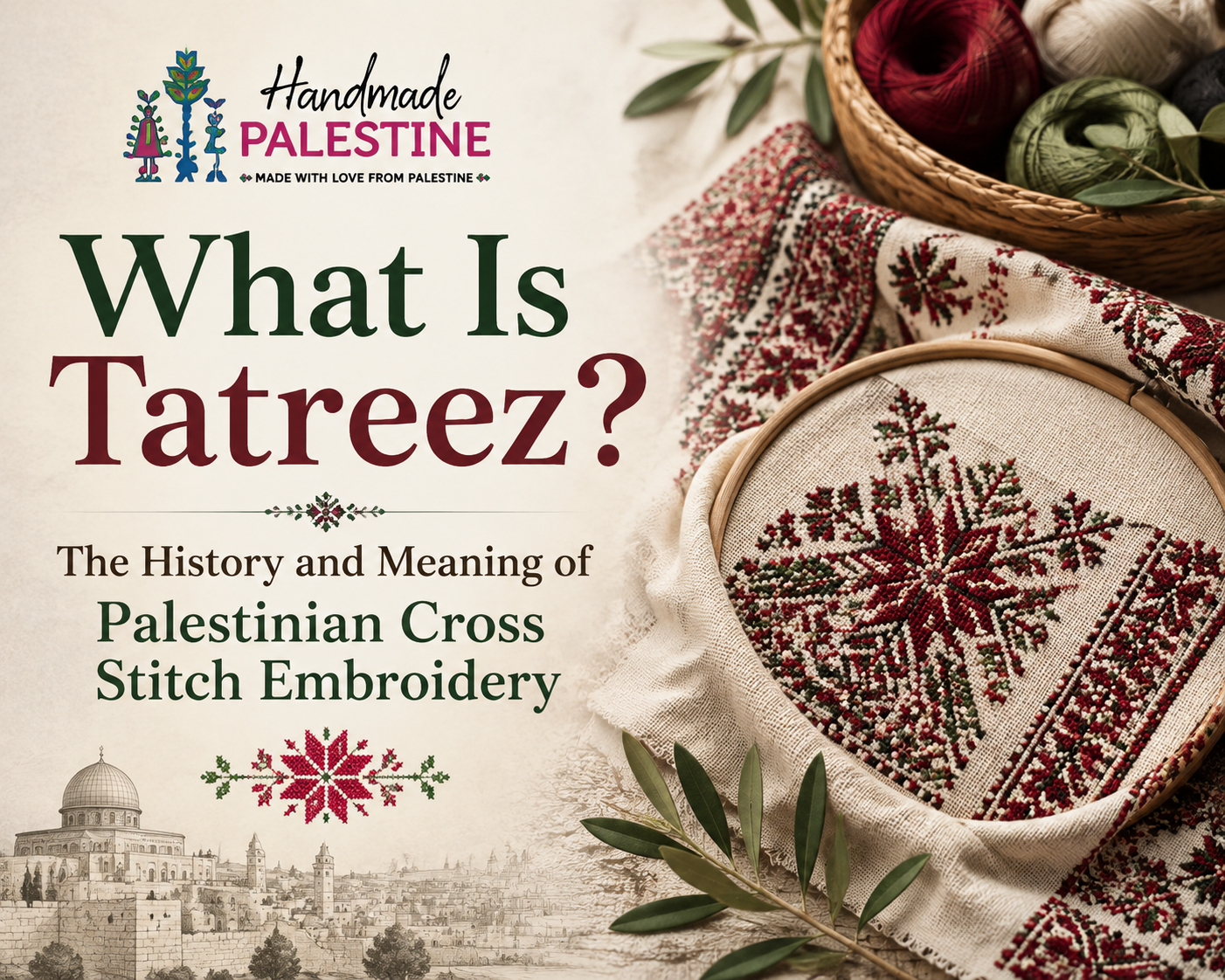
What Is Tatreez? The History and Meaning of Palestinian Cross Stitch Embroidery
There are forms of art that exist simply to be beautiful. And then there are forms of art that carry an entire people's history, geography, identity, and resistance within their stitches. Palestinian tatreez is the second kind.
Tatreez, Palestinian cross stitch embroidery, is one of the oldest and most sophisticated textile traditions in the world. For centuries, Palestinian women have stitched geometric patterns onto fabric in colored thread, creating garments, household items, and decorative pieces that are not merely beautiful objects but living documents of Palestinian culture. Every stitch carries meaning. Every motif tells a story. Every region of Palestine developed its own distinct patterns so distinct that a knowledgeable eye could once look at a woman's dress and identify exactly which village she came from.
This is tatreez. And understanding it is understanding something essential about Palestinian identity.
What Is Tatreez?

Tatreez (تطريز) is the Arabic word for embroidery. In a Palestinian context, it refers specifically to the tradition of Palestinian cross stitch embroidery, geometric patterns worked in cross stitch on fabric, typically using colored silk or cotton thread on a plain woven background.
The word comes from the Arabic root طرز (tarraza), meaning to embroider or to ornament. But tatreez is far more than ornamentation. It is a form of cultural memory, a language of identity, and a practice that has connected Palestinian women to their land, their communities, and each other across centuries.
Tatreez is worked entirely by hand. Each stitch is a cross of two diagonal stitches crossing at the center, placed with precision to build up larger geometric patterns. The work is time-intensive and requires skill, patience, and a deep knowledge of the patterns being worked. A single traditional Palestinian dress (thobe) embroidered with tatreez can take months to complete.
The History of Tatreez
The history of tatreez in Palestine stretches back thousands of years. Archaeological evidence suggests that embroidery traditions in the region date to ancient times, with Palestinian textile arts developing over millennia into the rich and regionally specific tradition that survived into the modern era.
By the nineteenth and early twentieth centuries, tatreez had developed into a highly sophisticated system of regional identity. Palestinian women embroidered their clothing, particularly the traditional thobe, the long Palestinian dress with patterns specific to their village or region. The patterns were not chosen at random; they were inherited, taught by mothers to daughters, and carried the specific visual vocabulary of a particular place and community.
This regional specificity meant that tatreez functioned almost like a map of Palestine. The patterns of a woman from Ramallah differed from those of a woman from Hebron, which differed from those of a woman from Bethlehem or Gaza or the Galilee. Colors, motifs, arrangements, and stitching techniques all varied by region, a visual language so precise that it encoded geographic and communal identity into every garment.
When Palestinian communities were displaced in 1948 and afterward, tatreez took on a new dimension of meaning. In refugee camps and diaspora communities, Palestinian women continued to embroider not just because it was a craft tradition, but because it was a connection to the villages they had been forced to leave. The patterns they stitched were the patterns of their homes. To embroider was to remember, to claim, to refuse to forget.
This is why tatreez has become one of the most powerful symbols of Palestinian cultural continuity and resistance. In 2021, UNESCO inscribed Palestinian embroidery on its list of Intangible Cultural Heritage, an international recognition of what Palestinian women have always known: that tatreez is irreplaceable.
The Patterns and What They Mean
The patterns of Palestinian tatreez are geometric grids, diamonds, triangles, zigzags, stars, and crosses, built from the fundamental unit of cross-stitch. But within this geometric framework, the range of expression is extraordinary.
Different regions developed different signature motifs:
The cypress tree appears in the embroidery of many Palestinian villages and represents uprightness, endurance, and connection to the Palestinian landscape.
The palm tree is associated with the Jordan Valley and the coastal plain regions where date palms have been cultivated for millennia.
Birds, particularly the hoopoe, the bird associated with Palestine, appear across many regional traditions as symbols of beauty, freedom, and the land itself.
Geometric stars and diamonds are among the most common motifs across all regions, their specific arrangement and proportion varying by village tradition.
The moon and crescent appear in some regional traditions, reflecting the intersection of Palestinian cultural and spiritual life.
Beyond specific motifs, the overall composition of tatreez the balance of pattern and open space, the choice of colors, the density of stitching also carries regional meaning. The bold, densely embroidered chest panel of a Hebron dress reads differently from the lighter, more open patterns of a Galilee garment. These differences are not merely aesthetic; they are geographic and communal signatures.
Tatreez and Palestinian Women
Tatreez has always been the work of Palestinian women. It was taught by mothers to daughters, by grandmothers to granddaughters, passed down as both a practical skill and a form of cultural inheritance. A young Palestinian woman learning tatreez was not just learning a craft; she was learning her family's patterns, her village's visual language, her community's identity.
Traditionally, a Palestinian bride would embroider her own wedding dress, a thobe, worked in the patterns of her village, demonstrating her skill and her connection to her heritage. The embroidery was not a decoration added to a dress; it was an expression of identity woven into the garment itself.
Under occupation, tatreez has taken on additional layers of meaning. For Palestinian women who can no longer access their villages through displacement, through the restrictions of occupation, through the simple reality of living in exile, the patterns of tatreez are a form of return. To embroider the patterns of your grandmother's village is to claim that village, to insist that it still exists, to refuse the erasure that displacement tries to impose.
At Handmade Palestine, we work with women artisans across Palestine who practice tatreez embroidery, whose skill and knowledge represent generations of accumulated tradition. Many of these women are the sole providers for their families. Their craft is not supplementary income; it is essential. When you purchase a tatreez piece from Handmade Palestine, you are paying directly for the skilled labor of these women and supporting their ability to continue this tradition.
Meet the artisans behind Handmade Palestine →
Tatreez Today: Preservation and Resistance
Tatreez faces real threats in the contemporary world. The time required to produce traditional tatreez by hand makes it economically challenging in a marketplace that rewards speed and low cost. The knowledge of regional patterns once passed organically from mother to daughter is at risk as communities remain displaced and the specific village traditions become harder to maintain.
At the same time, tatreez has never been more globally visible. Palestinian artists, designers, and activists have brought tatreez into contemporary fashion, art, and cultural spaces worldwide. The patterns that once identified a woman's village now appear on protest banners, international runways, gallery walls, and solidarity merchandise, a sign that Palestinian cultural identity cannot be suppressed.
Handmade Palestine is part of this effort to preserve and promote tatreez. Since 2022, we have provided artisans with training in branding, marketing, design, and pricing, helping tatreez makers connect their traditional craft with international markets. In 2023, we expanded into product design partnerships, working with artisans from conceptualization to finished product to create pieces that honor the tatreez tradition while reaching new audiences.
Tatreez and the Keffiyeh: Two Expressions of Palestinian Textile Identity
Tatreez and the keffiyeh are both Palestinian textile traditions, but they are distinct crafts with different techniques, histories, and cultural roles.
The keffiyeh is woven on a loom, its pattern built from the interlacing of black and white threads during the weaving process. It is produced in a factory setting, and its pattern, while regionally specific to Palestine, is standardized across the tradition.
Tatreez is worked entirely by hand in cross stitch, each stitch placed individually by the embroiderer. It is deeply personal and regionally specific, with each village and family tradition producing patterns that are uniquely their own. No two pieces of tatreez are the same.
Together, these two crafts represent the breadth of Palestinian textile heritage: the woven and the embroidered, the collective and the individual, the garment worn by all Palestinians and the dress that identifies a specific woman from a specific place.
Explore our keffiyeh collection →
How to Care for Tatreez Pieces
Tatreez embroidery is delicate and should be handled with care:
Washing: Hand wash gently in cool water with a mild detergent. Do not scrub the embroidered areas; agitate gently and rinse thoroughly.
Drying: Do not wring or tumble dry. Press out excess water gently with a clean towel and lay flat to dry, away from direct sunlight, which can fade the thread colors over time.
Ironing: If ironing is needed, iron on the reverse side of the embroidery on a low heat setting, with a pressing cloth between the iron and the fabric. Never iron directly on the embroidered surface.
Storage: Store folded carefully, away from direct light and moisture. Avoid storing in plastic bags, which can trap humidity; use a clean cotton bag or wrap in acid-free tissue paper for long-term storage.
Frequently Asked Questions About Tatreez
Q: What does tatreez mean?
A: Tatreez (تطريز) is the Arabic word for embroidery. In a Palestinian context, it refers specifically to the tradition of Palestinian cross stitch embroidery, geometric patterns hand-stitched in cross stitch onto fabric, with each region of Palestine developing its own distinctive patterns and motifs.
Q: How is tatreez different from regular embroidery?
A: Tatreez is a specific form of cross stitch embroidery with a distinct visual vocabulary rooted in Palestinian geography and culture. The patterns are geometric, regionally specific, and carry cultural meaning that goes far beyond decoration. It is not simply embroidery; it is a living record of Palestinian identity.
Q: Is tatreez still practiced today?
A: Yes, tatreez is actively practiced by Palestinian women both inside Palestine and in diaspora communities worldwide. It has also entered contemporary art, fashion, and design spaces globally. Organizations like Handmade Palestine work to ensure that tatreez artisans can sustain their practice economically and pass their knowledge to younger generations.
Q: What is a tatreez thobe?
A: A thobe is the traditional Palestinian women's dress, a long, flowing garment embroidered with tatreez patterns specific to the wearer's village or region. The embroidery on a traditional thobe can take months to complete and represents some of the most sophisticated examples of Palestinian cross stitch embroidery. Each thobe is a unique cultural document.
Q: Where can I buy authentic tatreez pieces?
A: At Handmade Palestine, we work directly with tatreez artisans across Palestine women whose skill and knowledge represent generations of embroidery tradition. Every tatreez piece in our collection was made by hand by these artisans, who receive fair wages for their work.
Written by Morgan Totah
Visit author's website


Leave a comment
This site is protected by hCaptcha and the hCaptcha Privacy Policy and Terms of Service apply.