
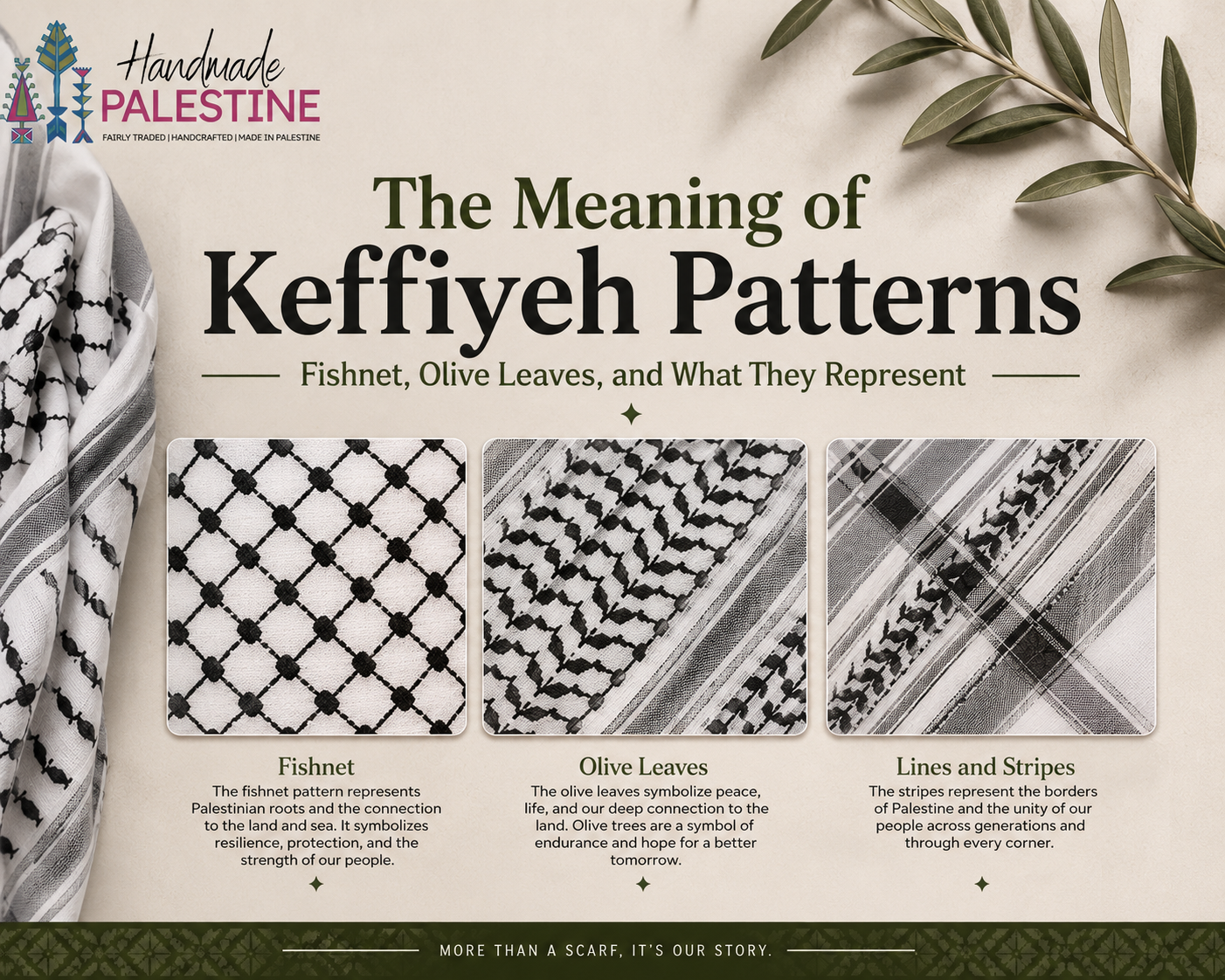
The Meaning of Keffiyeh Patterns: Fishnet, Olive Leaves, and What They Represent
The Palestinian keffiyeh is one of the most recognized symbols in the world. Most people who encounter it know it by sight: the bold black-and-white woven pattern, the distinctive border, the fringed edges. But far fewer people know what the pattern actually means, where each element comes from, and why these specific motifs were woven into a garment that Palestinian farmers and workers wore in their daily lives for centuries.
This is not decoration for its own sake. Every element of the traditional Palestinian keffiyeh carries meaning rooted in the land, the sea, the olive groves, and the communities that have called Palestine home for generations. Understanding the pattern is understanding a piece of Palestinian identity itself.
This guide explains exactly what each element of the keffiyeh pattern represents, and why it matters.
First: How the Pattern Is Made

Before discussing what the pattern means, it is worth understanding how it is made because the way the keffiyeh is produced is part of its meaning too.
The keffiyeh pattern is not embroidered. It is woven directly into the fabric from black and white threads during the weaving process itself. This means the pattern is inseparable from the fabric; it is not applied on top; it is the fabric. The black and white threads are interlaced during weaving to create the pattern, which is why a traditional keffiyeh has a visible front side (where the pattern is crisp and defined) and a back side (where the weave structure is more visible and textured).
This distinction matters because it reflects the nature of Palestinian craft: the keffiyeh's pattern is not ornamental; it is structural. It is built into the garment at the most fundamental level, just as Palestinian identity and connection to the land are built into the people who have worn it.
Our keffiyehs at Handmade Palestine are made by a Palestinian-owned factory that has kept this weaving tradition alive across generations of displacement and occupation. Meet the artisans and people behind our work →
The Fishnet Pattern: The Mediterranean Sea and Palestinian Fishing Communities
The most prominent visual element of the traditional Palestinian keffiyeh is the fishnet pattern, the open, interlocking grid design that covers the main body of the scarf.
This pattern is widely understood to represent Palestinian fishing communities and their historic connection to the Mediterranean Sea. Palestine has a long coastline, and fishing has been part of Palestinian life for millennia. The fishnet motif is a direct reference to the nets used by Palestinian fishermen, woven into the fabric as a reminder that Palestinian identity is rooted in a specific geography, with specific landscapes, coastlines, trades, and traditions.
It is a reminder that Palestine is not an abstract idea; it is a place with a sea, a shore, and generations of people who lived and worked along it. The fishnet pattern on the keffiyeh carries that memory even for Palestinians who have been displaced far from the Mediterranean.
In a broader sense, the fishnet also represents the interconnection of Palestinian communities, individual threads crossing and supporting one another, forming a structure stronger than any single strand. This reading of the pattern resonates deeply with the Palestinian experience of diaspora and collective solidarity.
The Olive Leaf Border: Resilience, Roots, and the Land
Running along the border of the traditional Palestinian keffiyeh is a pattern representing olive leaves and branches woven directly into the fabric rather than sewn on top.
The olive tree is perhaps the most powerful symbol in Palestinian culture, and its presence on the keffiyeh is no accident.
Olive trees in Palestine are ancient. Many of the olive trees still standing in Palestinian villages today are hundreds, sometimes thousands of years old. They have been planted, tended, and harvested by Palestinian families across countless generations. The olive harvest is not just an agricultural event in Palestinian life; it is a communal ritual that connects families to their land, to each other, and to their ancestors.
For Palestinians, the olive tree represents:
Rootedness. Olive trees have extraordinarily deep root systems. They are almost impossible to kill or cut down, and they grow back from the roots. This stubbornness, this refusal to be erased, mirrors the Palestinian concept of sumud, steadfastness, the determination to remain connected to the land and to one's identity no matter what forces are brought to bear against it.
Inheritance. Olive trees are planted by one generation for the next. A Palestinian farmer who plants an olive tree today knows that tree will be harvested by their grandchildren. To plant an olive tree in Palestine is an act of faith in the future, a declaration that you intend to remain, that your family will remain, that the connection between your people and this land will outlast any attempt to sever it.
Livelihood. Palestinian olive oil has been produced and traded for centuries. For many Palestinian families, the olive harvest is the primary source of annual income, a livelihood that occupation and land confiscation have threatened but not destroyed.
The olive leaf border on the keffiyeh carries all of this. It is not merely decorative; it is a statement about who the Palestinian people are and where they come from. Every time the keffiyeh is folded into its characteristic triangle, the olive leaf border frames the garment's edge, literally bordering Palestinian identity with the symbol of their deepest roots.
The Bold Stripes Structure and Strength
Running across the keffiyeh alongside the fishnet pattern are bold, thick stripes typically in black on white. These stripes provide the visual structure of the garment and frame the fishnet pattern.
The stripes are sometimes interpreted as representing the trade routes that historically crossed Palestine, the ancient paths along which goods, people, and culture moved through the region. Palestine's geographic position at the crossroads of Africa, Asia, and Europe made it a hub of trade and cultural exchange for millennia, and the keffiyeh's stripes are read by some as a reference to this history.
Others interpret the bold stripes as simply representing strength and structure, the framework within which Palestinian life and identity are held together. Like the threads of the fishnet, the stripes are both structural and symbolic.
The Fringe Completion and Connection
The fringed edges of the keffiyeh are one of its most visually distinctive features: the loose threads that hang from the border of the scarf. In Palestinian textile tradition, fringe is not an afterthought; it is the natural completion of the weaving process, where the warp threads of the loom extend beyond the woven structure.
The fringe also carries symbolic meaning. In many cultural traditions across the Middle East, fringe on a garment represents connection; the threads that hang loose are the points of contact between the garment and the world beyond it. For the keffiyeh, the fringe can be understood as the points of connection between Palestinians and the wider world: the diaspora communities, the solidarity movements, the international networks that have kept Palestinian identity alive far beyond the borders of Palestine.
Black and White: A Specific Choice
The traditional Palestinian keffiyeh is black and white, and this is not simply a matter of aesthetics or availability. The black-and-white color combination has become inseparable from Palestinian national identity, particularly from the 1930s onward when the keffiyeh became a symbol of resistance during the Great Arab Revolt.
Palestinian farmers and peasants who already wore the keffiyeh as part of their traditional daily dress began using it to cover their faces as they resisted British colonial rule. The garment they had always worn became a symbol of their resistance. And the black-and-white pattern, worn by Palestinians across all classes and regions during this period, became the color of Palestinian solidarity.
Today, when someone wears a black-and-white keffiyeh, the association with Palestine is immediate and globally understood. The color combination is not decorative; it is declarative.
Tatreez and the Keffiyeh: Two Traditions, One Identity
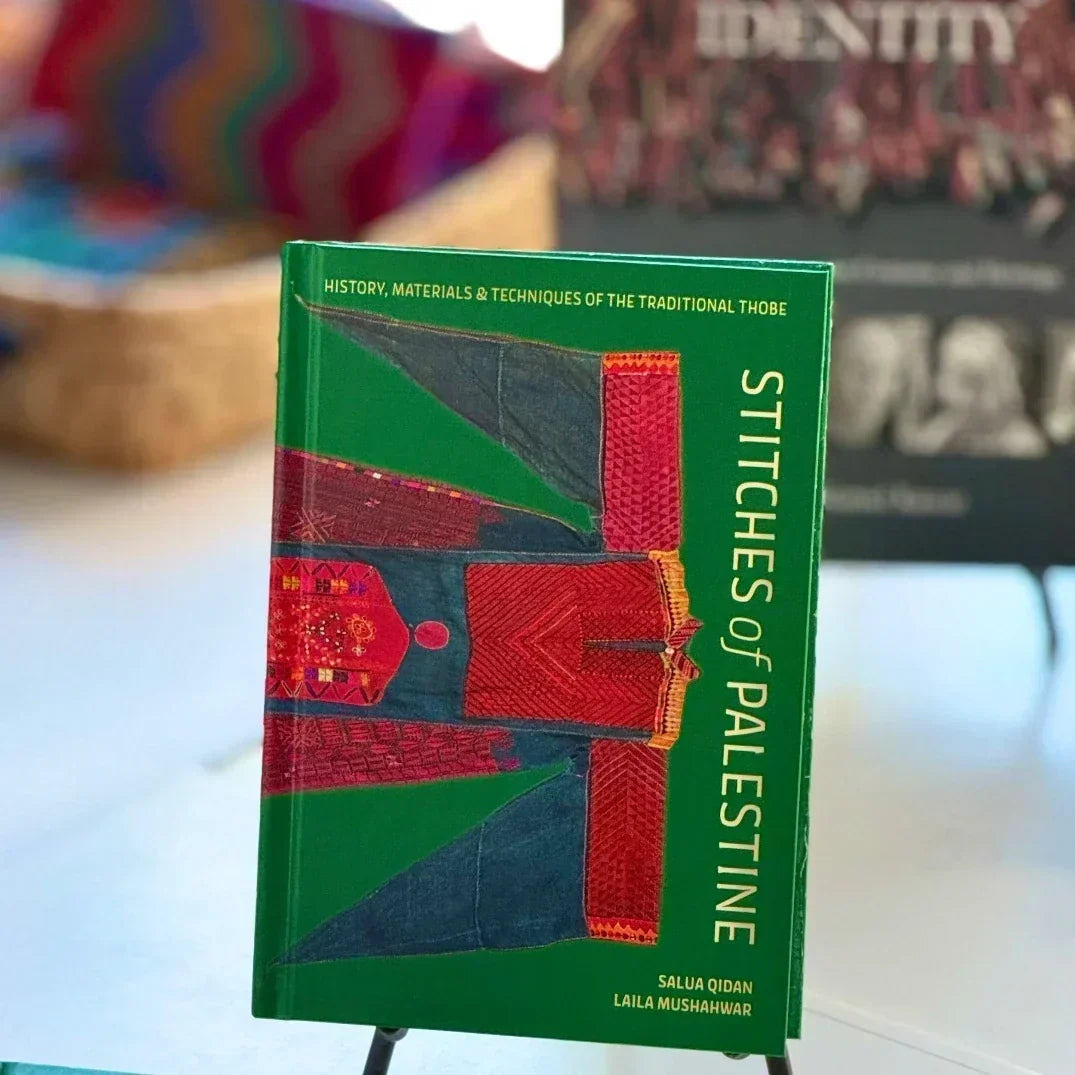
The keffiyeh pattern is one expression of Palestinian textile identity. Another is tatreez, Palestinian cross-stitch embroidery, a tradition of hand-stitched geometric patterns worked in cross stitch that Palestinian women have practiced for centuries, with each region of Palestine developing its own distinctive motifs and color combinations.
While the keffiyeh is a woven garment produced on a loom, tatreez is worked by hand in cross stitch, a more intimate, time-intensive form of craft. Both traditions are expressions of the same deep Palestinian connection to textiles as a form of cultural memory and identity.
At Handmade Palestine, we work with artisans who practice both traditions: weavers who produce keffiyehs and embroiderers who practice tatreez. Both crafts are forms of resistance: ways of saying, through the making of beautiful things, that Palestinian culture is alive, that it continues, and that it will be passed on.
Explore our tatreez collection →
Why Wearing the Pattern Matters
Understanding what the keffiyeh's pattern represents changes what it means to wear it. It is not a graphic print chosen for visual appeal. It is a textile document, a record of Palestinian connection to the sea, to the olive groves, to the land, and to one another.
When you wear a keffiyeh in solidarity with Palestinians, you are wearing the fishnet that references Palestinian fishing communities. You are wearing the olive leaf border that represents centuries of rootedness and resilience. You are wearing the black-and-white threads that became the color of Palestinian resistance in the 1930s and have never stopped carrying that meaning.
And when your keffiyeh was made by Palestinian hands by the workers and artisans who have kept this craft alive through decades of occupation and displacement — the pattern carries the additional weight of their labor and their livelihood.
Shop our Palestinian keffiyeh collection →
Frequently Asked Questions About the Keffiyeh Pattern
Q: Is the keffiyeh pattern embroidered?
A: No. The pattern on a traditional Palestinian keffiyeh is woven directly into the fabric from black and white threads during the weaving process. It is not embroidered or printed on top of the fabric. This is why the keffiyeh has a distinct front side where the pattern is crisp and clear and a back side, where the weave structure is more visible.
Q: What does the fishnet pattern on the keffiyeh mean?
A: The fishnet pattern is widely understood to represent Palestinian fishing communities and their historic connection to the Mediterranean Sea. It is a reminder that Palestinian identity is rooted in a specific geography: a land with a coastline, a sea, and generations of people who lived and worked along it.
Q: Why is there an olive leaf border on the keffiyeh?
A: The olive tree is one of the most powerful symbols in Palestinian culture, representing rootedness, resilience, inheritance, and livelihood. The olive leaf border on the keffiyeh reflects the deep connection between the Palestinian people and their land, and carries the concept of sumud, steadfastness that is central to Palestinian identity.
Q: Why is the traditional Palestinian keffiyeh black and white?
A: The black-and-white keffiyeh became the color of Palestinian national solidarity during the Great Arab Revolt of the 1930s, when Palestinian farmers and peasants wore it while resisting British colonial rule. The color combination became inseparable from Palestinian identity from that point on, and today it is immediately recognized globally as a symbol of Palestinian resistance and solidarity.
Q: What is the difference between the keffiyeh pattern and tatreez?
A: The keffiyeh pattern is woven on a loom as part of the fabric itself. Tatreez is Palestinian cross-stitch embroidery with geometric patterns hand-stitched in cross-stitch onto fabric by Palestinian women, with each region of Palestine having its own distinctive motifs and color combinations. Both are expressions of Palestinian textile identity, but they are distinct crafts with different techniques and traditions.
Written by Morgan Totah
Visit author's website


Leave a comment
This site is protected by hCaptcha and the hCaptcha Privacy Policy and Terms of Service apply.