
Palestinian Olive Wood: The Ancient Craft Behind Every Piece
The olive tree is the oldest living symbol of Palestine. It has been cultivated in Palestinian soil for millennia, planted and tended across countless generations of families who pressed its fruit into oil, harvested its olives at the turning of every autumn, and found in its steadfast, rooted permanence a mirror of their own connection to the land.
And when the olive tree is pruned as it must be, regularly, to thrive, its branches do not go to waste. In the hands of Palestinian artisans in Bethlehem, those branches become something else entirely: dense, fragrant, beautifully grained wood that is carved and shaped by hand into objects of extraordinary quality and quiet beauty.
This is Palestinian olive wood craft. And understanding it begins with understanding the tree.
The Olive Tree in Palestinian Life

The olive tree occupies a place in Palestinian culture that goes far beyond agriculture. Many of the olive trees currently standing in Palestinian villages are hundreds of years old, some ancient beyond reckoning. They have been planted by generations of Palestinian families who knew that an olive tree, once established, would outlast any individual life and provide for the children and grandchildren not yet born.
The olive harvest in Palestine is not merely an agricultural event. It is one of the most important communal rituals of Palestinian life, a time when families travel to their land, gather together, and harvest side by side. The harvest connects living Palestinians to their ancestors who harvested the same trees, and to the land itself most directly and physically possible.
Palestinian olive oil produced from these trees has been traded and prized for centuries from ancient Mediterranean routes to modern international markets. The olive is woven into Palestinian food, Palestinian medicine, Palestinian ceremony, and Palestinian identity at the deepest level.
The olive tree also represents sumud, the Palestinian concept of steadfastness and rootedness. Olive trees are almost impossible to kill. Cut them down, and they grow back from the roots. They endure. This endurance mirrors what Palestinians call upon in themselves: the refusal to be uprooted, the insistence on remaining connected to the land.
Where Palestinian Olive Wood Comes From

Palestinian olive wood is sustainably sourced, and this sustainability is built into the nature of the craft itself.
Olive trees are never cut down for their wood. The wood used in Palestinian olive wood craft comes from the branches pruned from living olive trees during the regular pruning that olive trees need to remain productive and healthy. These pruned branches, dense, fragrant, and beautifully grained, are what Palestinian artisans work with.
The olive wood used in Handmade Palestine pieces comes from ancient olive trees in Nablus and Jenin, some of the oldest and most storied olive groves in Palestine. Nothing is wasted. The branches that are removed to help the tree thrive become the raw material for craft objects that carry the character of those ancient trees their grain, their color, their density into the hands of people around the world.
Because every branch is different, every piece of olive wood is different. The wood is dense, fragrant, and individual: no two pieces carry the same grain. This means that every olive wood piece from Handmade Palestine is, in a literal sense, unique.
The Artisans of Bethlehem
Palestinian olive wood craft is centered in and around Bethlehem, a city with a long and deep tradition of Christian Palestinian artisans producing carved objects for pilgrims, travelers, and international markets.
Our olive wood pieces are carved in Bethlehem by artisans whose workshops have been passed from father to child for generations. Each workshop specializes; one artisan or workshop may focus on kitchen utensils, another on serving pieces, another on decorative objects. Usually, each olive wood workshop in Bethlehem specializes in making certain items, and sometimes even parts of an item which are then assembled.
This specialization reflects a deep craft knowledge built up over generations. The artisans who carve olive wood in Bethlehem are not general woodworkers; they are specialists whose understanding of olive wood's specific qualities, its grain, its density, and its behavior under carving tools has been developed and refined across lifetimes of practice.
At Handmade Palestine, we work with multiple artisan workshops in Bethlehem to bring together their specialized skills into curated collections.
What Is Made From Palestinian Olive Wood
Palestinian olive wood artisans produce a wide range of objects from small kitchen tools to serving pieces, decorative items, and religious objects. You will find cooking utensils, serving bowls, honey dippers, cutting boards, coffee scoops, and ma'amoul moulds the wooden press used to shape the date-filled pastries made at Eid and Christmas across the Arab world.
Kitchen and Serving Pieces
The most widely used Palestinian olive wood products are kitchen and serving pieces, tools designed for daily use that bring the beauty and quality of Palestinian olive wood into the most ordinary moments of daily life.
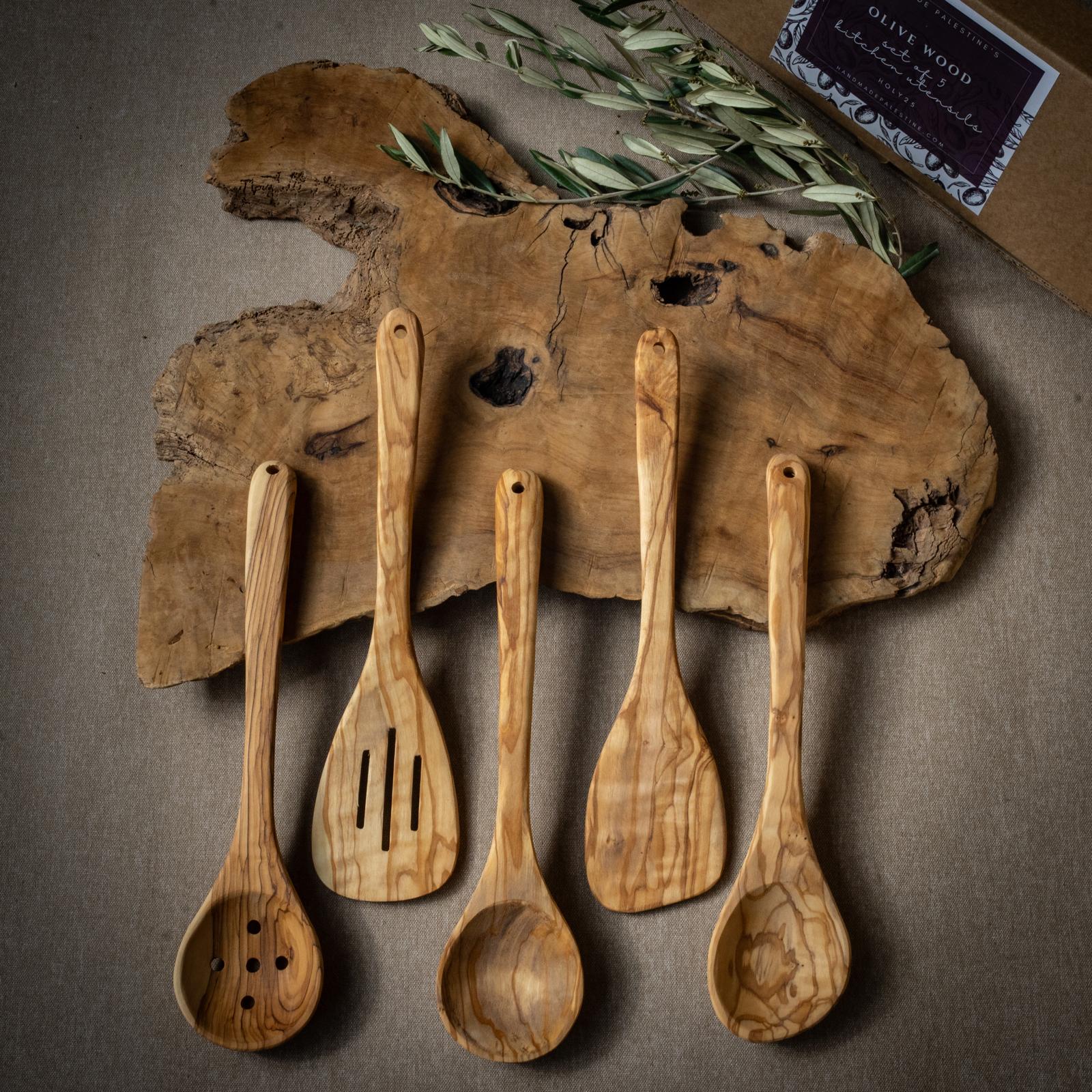
Cooking utensils: spoons, spatulas, and slotted spoons for everyday cooking. Olive wood is naturally resistant to bacterial growth, doesn't warp easily, and handles heat well, making it genuinely practical as well as beautiful.
Curated kitchen set: a curated collection combining the work of multiple Bethlehem artisan workshops into one set, including a cutting board, spatula, spoons, a lemon reamer, and a honey dipper.
Serving dishes and platters: hand-carved serving pieces that are as beautiful on a table as they are practical for use.
Honey dippers: a small but perfectly formed olive wood piece that has become one of the most popular Palestinian olive wood gifts.
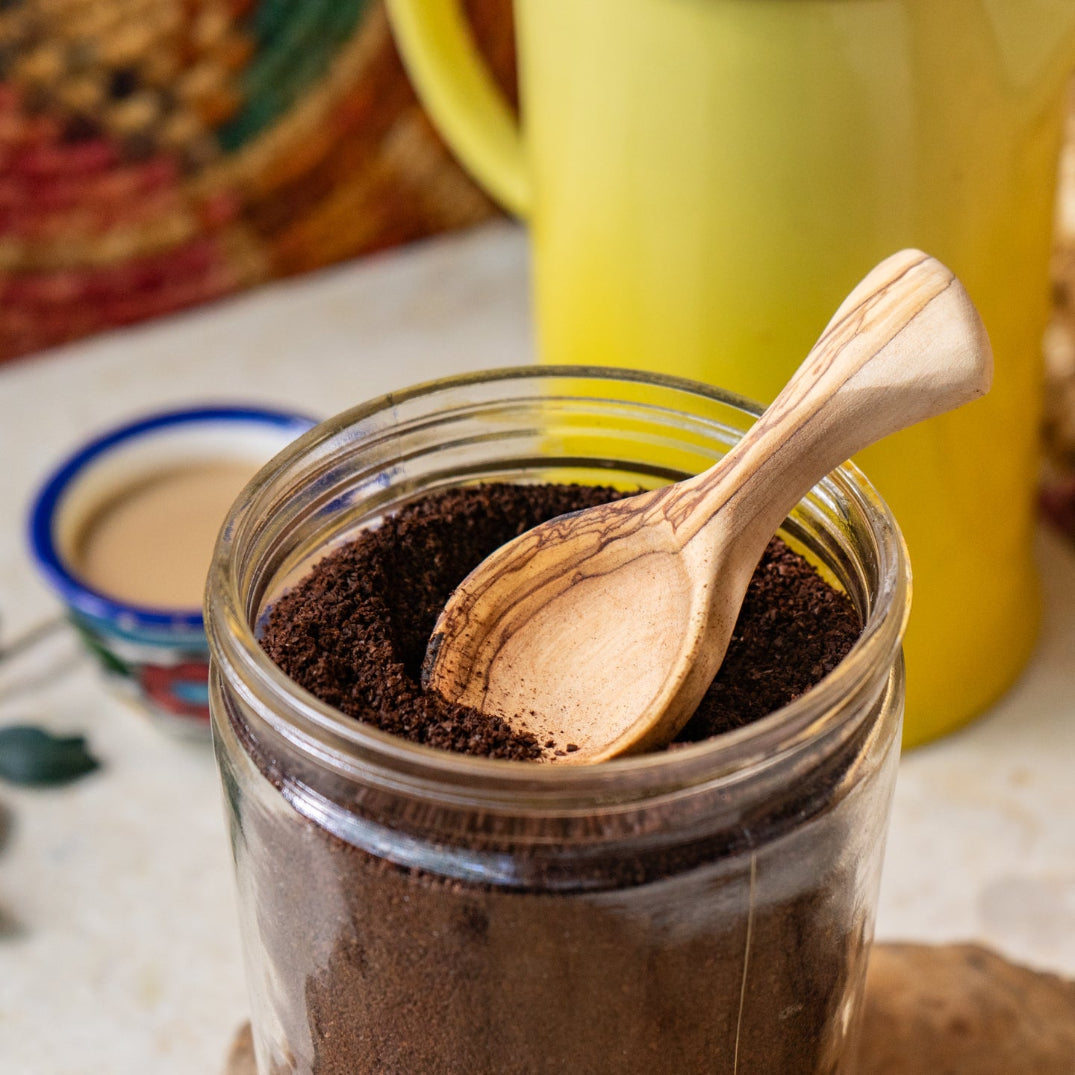
Coffee scoops: a natural fit for Palestinian coffee culture and a beautiful, everyday-use gift.
Ma'amoul moulds: traditional wooden presses used to shape ma'amoul, the date and nut-filled pastries made at Eid and Christmas. These are among the most culturally specific Palestinian olive wood objects tied directly to Palestinian celebration and communal life.
Decorative, Religious Objects and Ornaments
Palestinian olive wood artisans also produce decorative and religious objects: nativity sets, crosses, prayer beads, ornaments, and other devotional pieces that reflect the long tradition of Bethlehem craftsmanship for pilgrims and the global Christian community.
Nativity sets: hand-carved olive wood nativity scenes are among the most iconic Palestinian olive wood objects, made by skilled artisans in Bethlehem. Both small simple sets and elaborate multi-figure collections are available.
Prayer beads: hand-carved olive wood prayer beads for use in Christian and other devotional practices.
Ornaments and decorative pieces: hand-carved olive wood ornaments and decorative items, perfect as gifts or as a way to bring a piece of Palestine into your home.
The Quality of Palestinian Olive Wood
Olive wood is known for its strength, durability, and beautiful natural grain. It is one of the densest hardwoods available, significantly heavier and harder than most common kitchen woods. This density makes it exceptionally durable: a well-cared-for piece of Palestinian olive wood will last for decades of regular use.
The grain of olive wood is one of its most distinctive visual qualities. The patterns created by the growth rings and the natural structure of the wood produce swirling, flowing lines that vary from piece to piece, sometimes dramatic, sometimes subtle, always unique. Olive wood has many beautiful shades and grains, from dark to white and from no grain to fully grained. No two pieces are ever identical.
Olive wood also has a natural fragrance: a faint, pleasant, woody scent that is characteristic of the wood and that lingers in pieces even after years of use.
How to Care for Palestinian Olive Wood
Proper care will keep your Palestinian olive wood pieces beautiful and functional for many years.
Washing: Wash with warm water and a small amount of gentle soap when needed. Do not soak olive wood in water or put it in a dishwasher; prolonged exposure to water can cause warping and cracking.
Drying: Towel dry immediately after washing. Do not leave olive wood pieces wet or allow them to air dry slowly; this can cause the wood to crack.
Oiling: Rub a small amount of food-safe olive oil (the natural choice) into the wood with your fingers or a cloth periodically and whenever the wood looks dry. This nourishes the wood, prevents cracking, and maintains the richness of the grain. Allow the oil to absorb before use.
Storage: Store olive wood pieces away from direct heat sources such as ovens, radiators, or direct sunlight, which can dry out and crack the wood.
With this simple care, a Palestinian olive wood piece will become more beautiful with age, the grain deepening, the surface developing a patina that reflects years of use and care.
Palestinian Olive Wood as a Gift
Palestinian olive wood pieces make some of the most meaningful and practical gifts available. They are genuinely beautiful, genuinely useful, and genuinely made by Palestinian hands objects that carry a story into everyday life.
For a single gift, a honey dipper or coffee scoop is a beautiful, affordable introduction to Palestinian olive wood. For a more significant gift, the Curated Olive Wood Kitchen Set, which combines the work of multiple Bethlehem artisan workshops into a single collection of kitchen utensils, is one of our most loved pieces.
For occasions connected to Christmas or religious celebration, a hand-carved olive wood nativity set from Bethlehem is a gift that carries the specific weight of its place of origin in a way that few objects can.
Shop Palestinian olive wood pieces →
Frequently Asked Questions About Palestinian Olive Wood
Q: Is Palestinian olive wood sustainable?
A: Yes. Palestinian olive wood craft is inherently sustainable; the wood comes from branches pruned from living olive trees, not from trees cut down for their timber. The trees continue to live and produce olives. Nothing is wasted, and the craft supports the continued cultivation of Palestine's ancient olive groves.
Q: Why is every piece of olive wood different?
A: Because every branch of every tree is different. Olive wood's grain is determined by the specific growth patterns of the individual branch: the rings, the structure, the density. No two branches carry the same grain, which means no two pieces of olive wood carry the same pattern. Every piece is genuinely unique.
Q: Is olive wood good for kitchen use?
A: Yes, olive wood is one of the best hardwoods for kitchen use. It is exceptionally dense and hard, naturally resistant to bacterial growth, handles heat well, and does not warp easily with proper care. Palestinian olive wood kitchen pieces are designed for daily use and will last for decades with simple maintenance.
Q: Where are Handmade Palestine's olive wood pieces made?
A: Our olive wood pieces are hand-carved in Bethlehem by Palestinian artisans whose workshops have been passed down through generations. We work with multiple specialist workshops, each of which focuses on specific pieces.
Q: What olive wood pieces does Handmade Palestine offer?
A: We offer kitchen utensils, cutting boards, serving dishes and platters, honey dippers, coffee scoops, ma'amoul moulds, nativity sets, and prayer beads, all hand-carved in Bethlehem from sustainably sourced Palestinian olive wood.
Written by Morgan Totah
Visit author's website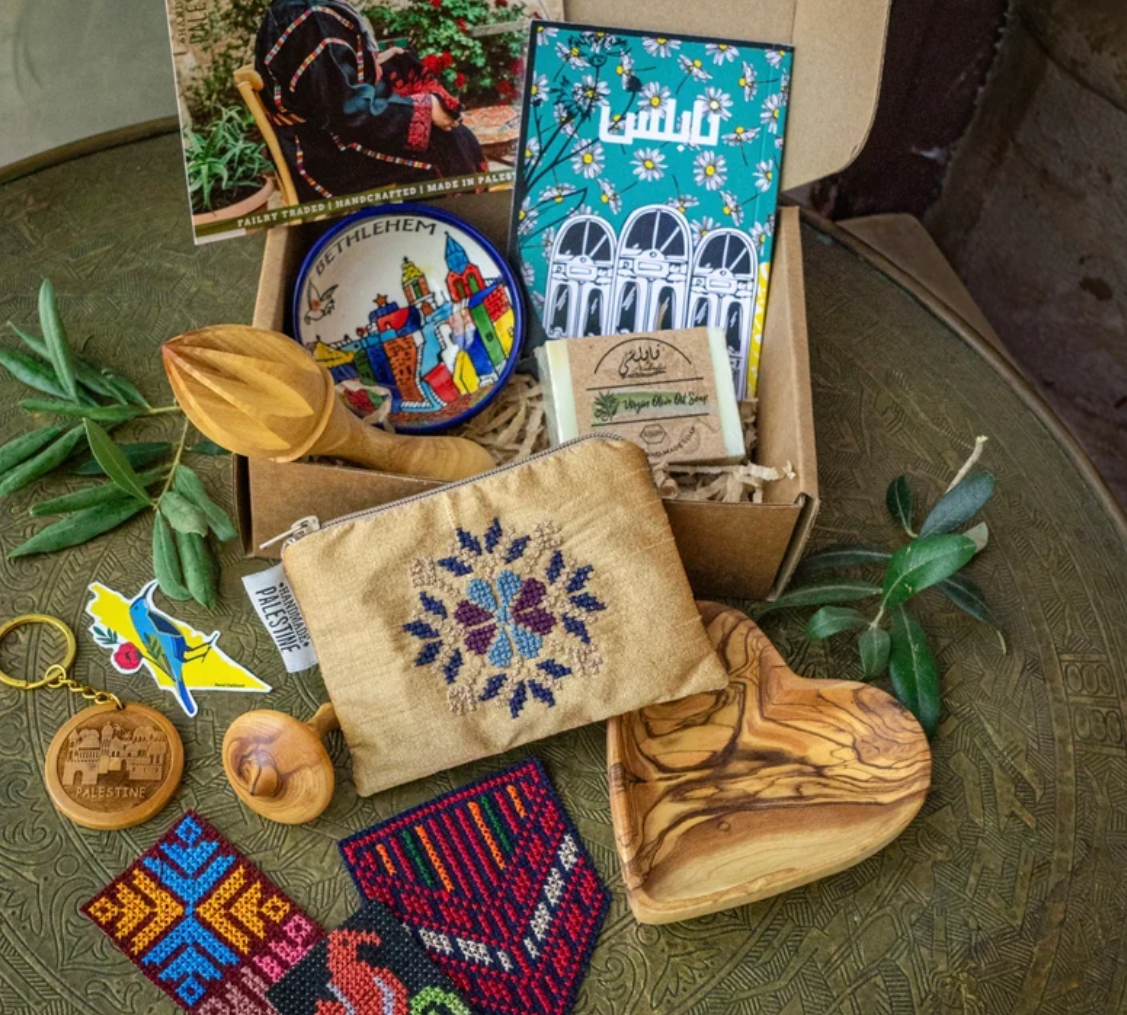


Leave a comment
This site is protected by hCaptcha and the hCaptcha Privacy Policy and Terms of Service apply.